Emergency Bag: 72h Bug Out Bag
Your BOB survival kit for evacuating in 5 minutes. An evacuation bag organised by priority layers. Know what to pack.
Your bag progress: 0%
What is a bug out bag?
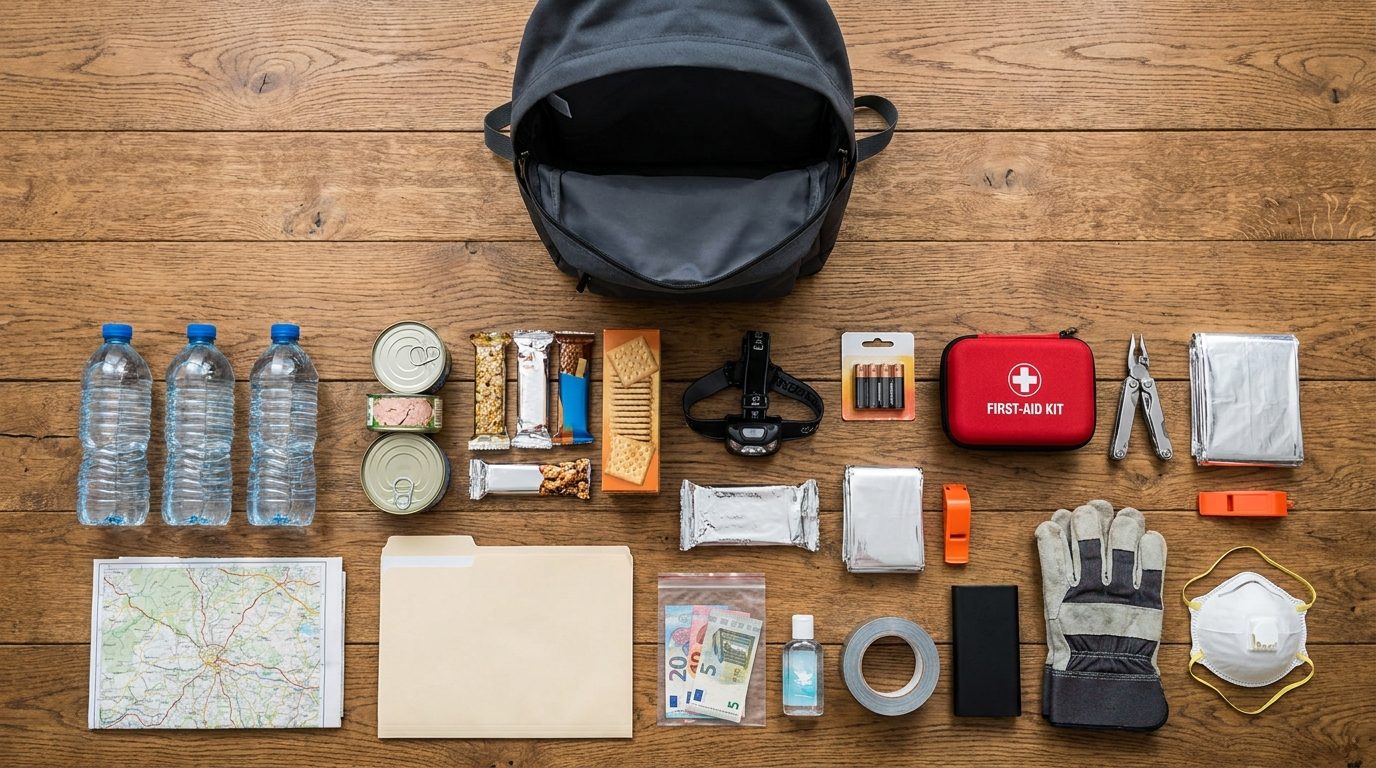
A bug out bag (BOB) or 72-hour emergency bag is a pre-packed bag that is always ready to grab and go in case of urgent evacuation. It should contain everything you need to survive independently for 3 days, without access to your home, electricity, running water, or shops. The goal is total autonomy while you travel to a safe location or await help.
Ideal weight: 8-15 kg maximum (10-15% of your body weight). It must be light enough to carry for hours on foot. Location: Keep it by the front door, in the car, or in an easily accessible spot. In case of fire, flood, earthquake, or other emergency, there is no time to pack. Just grab it and go.
The bag
Choosing the right bag is the first step. It should be sturdy, comfortable, and have enough capacity for everything you need. Here are three options for different budgets:
Decathlon Forclaz Trek 500 (50L)
EUR 35-45
Excellent value for money. 50-litre backpack with a dorsal frame, padded hip belt, multiple compartments, and water-resistant material. Ideal for beginners or those on a limited budget. Tested and approved on hiking trails.
Where to buy: Decathlon (physical stores and online)
Osprey Talon 44 / Deuter Futura 50+10
EUR 90-130
Mid-to-high range backpacks with back ventilation systems, adjustable straps, ultra-resistant ripstop fabric, and lifetime warranty. Very comfortable even with heavy loads on long hikes. Hydration system compartment included.
Where to buy: Sport Zone, Decathlon, Amazon.es, specialist shops
Mystery Ranch / Arc'teryx (60L+)
EUR 200-400
Top of the range. Military or extreme mountaineering packs with ballistic materials, professional weight distribution systems, and durability to last decades. Only if you want the very best and your budget allows it.
Where to buy: Amazon.es, specialist military shops, international websites
Must-have features in a BOB
- Capacity: 40-60 litres (50L is ideal)
- Water resistance: waterproof fabric or included rain cover
- Padded straps: to distribute weight across the shoulders
- Hip belt: essential for transferring weight from the back to the hips
- Multiple compartments: for organising by priority layers
- External attachment points: for securing a sleeping bag, tarp, or other gear
- Discreet colour: green, grey, or black. Avoid flashy colours
Layer 1: Survival (most important)
This is the critical layer: shelter, warmth, and basic tools. Without these, you will not survive a night outdoors. Prioritise these items above everything else.
Compact sleeping bag
EUR 25-60
Ultralight sleeping bag with a comfort temperature between 5 C and 10 C (suitable for the Portuguese climate most of the year). Choose synthetic fibre (cheaper, dries quickly) or down (more expensive, more compact). Should fit in a compression sack and weigh under 1 kg.
Where to buy: Decathlon (Forclaz Trek 500 15 C ~EUR 30), Sport Zone, Amazon.es
Insulating sleeping mat
EUR 12-30
EVA foam or self-inflating mat that insulates you from the cold ground. Extremely important, as sleeping directly on the ground drains body heat quickly. Foldable models are more compact than roll-up ones. Look for a minimum thickness of 1.5 cm.
Where to buy: Decathlon (Trek 500 M100 ~EUR 15), AliExpress (EUR 8-12)
Waterproof poncho / rain cape
EUR 10-25
Rain protection that also covers the backpack. Prefer large ponchos that can serve as an improvised tarp. Material should be PVC or reinforced polyester, with sealed seams. Avoid disposable capes, they do not last.
Where to buy: Decathlon, Leroy Merlin, AliExpress
Emergency thermal blankets
EUR 3-8 (pack of 5)
The well-known gold/silver blankets. They reflect up to 90% of body heat, are waterproof, and fit in your pocket. Buy a pack: they work for multiple people, can line the floor inside a shelter, or signal in an emergency (highly reflective). Essential and cheap, there is no excuse not to have them.
Where to buy: Pharmacies, Decathlon, Amazon.es, AliExpress (EUR 2-4)
Tarp / tarpaulin 3x3 metres
EUR 12-25
Multi-purpose waterproof tarp: improvised shelter, ground protection, equipment cover, or rainwater collection. Look for models with reinforced grommets at corners and edges. Green or camouflage colour. Ideal weight: 400-600 g.
Where to buy: Leroy Merlin, Decathlon, hardware stores, AliExpress
Paracord rope 15-30 metres
EUR 6-12
Parachute cord (paracord 550) holds 250 kg. Used for setting up shelters, repairs, traps, drying clothes, or even unwinding the inner strands for use as fishing line. Compact, lightweight, and incredibly versatile. Carry at least 15 m.
Where to buy: Decathlon, military stores, Amazon.es, AliExpress
Multi-tool knife / pocket knife
EUR 18-50
A good knife is the most important tool. Options: Victorinox Swiss Army knife (classic, multi-function) or a fixed-blade knife like a Morakniv (more robust for heavy work). 8-12 cm blade, stainless steel. Include a small sharpening stone.
Where to buy: Sport Zone, Decathlon, Amazon.es, Leroy Merlin
Headlamp
EUR 12-30
LED headlamp with at least 150 lumens, red light mode (to preserve night vision), and water resistance IPX4 or higher. Include extra AAA batteries or a USB rechargeable version. Frees your hands to work in the dark, far better than a handheld torch.
Where to buy: Decathlon (Forclaz ~EUR 15), Leroy Merlin, Amazon.es
Layer 2: Water and food
The survival rule: 3 minutes without air, 3 hours without shelter (extreme cold), 3 days without water, 3 weeks without food. Water is the top priority. Always carry a way to purify it. Do not rely on finding potable water.
Canteen / stainless steel bottle 1 litre
EUR 10-20
Stainless steel bottle or military canteen. Advantage over plastic: you can boil water directly over a fire to purify it. Carry at least 1 L. Ideally have 2 L total capacity (you can add a collapsible 1 L bottle that takes up little space when empty).
Where to buy: Decathlon, Leroy Merlin, military stores, Amazon.es
Micropur water purification tablets
EUR 10-15 (100 tablets)
Chlorine or chlorine dioxide tablets that purify water in 30 minutes. Each tablet treats 1 L. Light, compact, 5-year shelf life. Kill bacteria, viruses, and Giardia. Essential as a backup. Even if you have a filter, always carry tablets. A bottle of 100 = 100 L of safe drinking water.
Where to buy: Decathlon, pharmacies, Amazon.es
Portable filter: LifeStraw or Sawyer Mini
EUR 25-45
Portable water filter that removes 99.99% of bacteria and parasites. LifeStraw works like a straw (drink directly from the source). Sawyer Mini screws onto bottles. Each filter treats thousands of litres. Faster than tablets and does not alter the taste of the water. A worthwhile investment.
Where to buy: Decathlon, Sport Zone, Amazon.es
Energy bars
EUR 1.50-3 per unit (carry 10-15)
Cereal, nut, or protein bars with high caloric density (200-300 kcal each). Compact, require no preparation, last months. Choose flavours you like. Under stress, familiar food helps psychologically. Pack variety: cereal, chocolate, nuts. Total: 3,000-4,500 kcal.
Where to buy: Continente, Pingo Doce, Decathlon, pharmacies
Freeze-dried food / MRE
EUR 6-12 per meal
Dehydrated meals or MRE (Meal Ready to Eat) military rations. Just add hot water and wait 10 minutes. Each pouch = 1 complete meal (400-600 kcal). Shelf life: 5-25 years. Carry 6-9 meals (2-3 days). Brands: Travellunch, Adventure Food, military MREs.
Where to buy: Decathlon, Amazon.es, online military stores
Pocket stove + fuel
EUR 10-25
Compact gas stove (screw-on canister) or solid fuel tablets (Esbit). Allows you to heat water for dehydrated food, tea, or purification. Gas stoves are more efficient; solid tablets are simpler and safer. Include 3-4 gas canisters or 20 solid fuel tablets.
Where to buy: Decathlon, Leroy Merlin, Amazon.es
Camping cutlery set + metal mug
EUR 8-15
Folding spoon-fork-knife set (spork) in stainless steel or titanium, plus a 500 ml metal mug for heating water or cooking. Avoid plastic, it cannot withstand heat. A mug with measuring marks is handy for dosing water for dehydrated meals.
Where to buy: Decathlon, Leroy Merlin, AliExpress
Salt, sugar, instant coffee/tea
EUR 3-6
Individual sachets of salt, sugar, honey, and instant coffee or tea. Salt replenishes electrolytes, sugar provides quick energy, coffee/tea warms you and boosts morale. Carry 10-20 sachets of each in a ziplock bag. It may seem superfluous, but the psychological boost of a hot coffee in a stressful situation is enormous.
Where to buy: Supermarkets, bulk food shops
Watch the expiry dates
Energy bars last 6-12 months. Check and rotate stock every 6 months. Eat the old ones and replace with new. Freeze-dried food lasts years, but purification tablets have a 5-year shelf life. Mark everything with the purchase date using a permanent marker.
Layer 3: First aid and medication
Injuries and illnesses do not disappear in an emergency. On the contrary, they increase. A basic first aid kit can save lives. For a complete medication list, see the medications page.
Pre-made first aid kit
EUR 15-30
Basic kit with: bandages, sterile gauze pads, assorted plasters, scissors, tweezers, disposable gloves, disinfectant, saline solution. Kits from Decathlon or a pharmacy come well-equipped. Check the contents and add what is missing. Store in a waterproof case.
Where to buy: Pharmacies, Decathlon, Sport Zone
Essential medications
EUR 20-40 (total)
Indispensable basics: Paracetamol (pain/fever), Ibuprofen (inflammation), Loperamide (diarrhoea), Cetirizine (antihistamine). Add personal medication (asthma, diabetes, heart). For a complete list and dosages, see emergency medications.
Where to buy: Pharmacies (no prescription needed for most)
Sunscreen SPF 50+
EUR 8-15
Sunburn is debilitating and avoidable. Carry a small tube (50-100 ml) of SPF 50+, water resistant. Important if you are walking during the day in exposed terrain. Shelf life: 12 months after opening. Replace annually.
Where to buy: Pharmacies, supermarkets
Insect repellent DEET 50%
EUR 6-12
Mosquitoes and ticks transmit diseases (Lyme, Dengue). Repellent with DEET 50% provides 8-12 hours of protection. A small 100 ml spray is sufficient. Essential if you evacuate to rural or forested areas. Also apply to clothing.
Where to buy: Pharmacies (Relec, Autan)
Layer 4: Tools and communication
When the power grid goes down, smartphones die. You need alternative ways of communicating, lighting, and basic repair tools.
AM/FM dynamo + solar radio
EUR 18-35
Radio with multiple power sources: solar, dynamo (hand crank), and batteries/USB. Some models include an LED torch and USB charger for your phone. Essential for receiving ANEPC (Civil Protection) alerts, news, and evacuation instructions when internet and mobile phones are down. Look for models with FM + AM (long waves reach further).
Where to buy: Amazon.es (~EUR 20-30 for functional models), Radio Popular, Worten
Power bank 10,000-20,000 mAh + cables
EUR 20-40
External battery to charge your phone 3-5 times. Choose a 20,000 mAh model if possible; the extra weight is worth it. Include USB-C, Lightning (iPhone), and Micro-USB cables. Keep it fully charged at 100% (check monthly). Some models have a built-in torch, which is useful.
Where to buy: Worten, Radio Popular, Amazon.es, AliExpress
Emergency whistle
EUR 2-6
ABS plastic or metal whistle, minimum volume 100 decibels. Used to signal your position if you are trapped under rubble, lost, or need help. Sound travels much further than your voice (especially when exhausted). Clip it to your bag with a carabiner for quick access. Small, cheap, essential.
Where to buy: Decathlon, Sport Zone, Amazon.es, sports shops
BIC lighter + waterproof matches
EUR 3-8
Fire is vital: heating, cooking, water purification, signalling, morale. Carry at least 2 BIC lighters (reliable, cheap) and a box of waterproof matches (or waterproof regular ones with wax). Store in a separate ziplock bag. Add a magnesium fire striker (EUR 5) as a backup; it works when wet.
Where to buy: Supermarkets, tobacconists, Decathlon, Amazon.es
Duct tape
EUR 4-8
Mini roll of heavy-duty adhesive tape. Used to repair a torn bag, seal tarps, patch holes, immobilise sprains, fix footwear, mark paths, and a thousand other things. Wrap 5-10 metres around a small piece of card to save space. Also carry 10-15 cable ties (zip ties), which weigh nothing and solve a lot.
Where to buy: Leroy Merlin, hardware stores, Continente
Cable ties (zip ties)
EUR 3-6 (pack of 50-100)
Cable ties in various sizes (15-30 cm). Used to secure equipment, improvised repairs, close bags, build shelters, even immobilise injured limbs. A pack of 50 weighs 100 g and fits in your pocket. Carry a variety of sizes; you never know when you will need them.
Where to buy: Leroy Merlin, Amazon.es, hardware stores
Paper map of your region
EUR 8-15
GPS and Google Maps fail when the battery dies or there is no signal. A paper topographic map of your region (1:50,000 or 1:100,000 scale) never fails. Mark alternative evacuation routes, water sources, possible shelters. Laminate it or keep it in a ziplock bag. Include a basic compass (EUR 5-10).
Where to buy: Bookshops, Decathlon, FNAC, mountaineering shops
Extra AAA / AA batteries
EUR 6-12
Pack of 8-12 AAA and AA batteries for your headlamp, radio, and other equipment. Prefer alkaline (last longer) or lithium (work in extreme cold, 10+ year shelf life). Store in original packaging inside a ziplock bag. Check the expiry date annually.
Where to buy: Supermarkets, Worten, Radio Popular
Layer 5: Documents and personal items
Without documents, it is much harder to access aid, cross borders, or prove your identity. Physical cash works when card machines and ATMs do not.
Document copies in a ziplock bag
EUR 2-5 (ziplock + photocopies)
Colour copies of: ID card (both sides), driving licence, bank cards (front), vaccination booklet, medical prescriptions, insurance policies, property deeds, vehicle documents. Store everything in a double waterproof ziplock bag. Also consider an encrypted USB drive with digital scans.
Where to buy: Ziplock bags at supermarkets; photocopies at stationery shops
Cash in notes (EUR 100-200)
EUR 100-200
Notes of EUR 5, 10, 20, and 50 (avoid EUR 100 and 200 notes, they are hard to change). When ATMs are down or banks are closed, cash is king. You can buy food, fuel, or pay for transport. Hide it in several places in your bag (if one stash is stolen, you do not lose everything). Also consider USD 50-100 (accepted internationally).
Where to get: Withdraw from your bank and set aside specifically for the BOB
Handwritten contact list
EUR 0 (paper + pen)
List with phone numbers of family, close friends, doctor, insurer, embassy. Nobody memorises phone numbers nowadays. If you lose your phone, you cannot contact anyone. Write it by hand on a laminated card or paper inside a ziplock. Include international emergency contacts if you have family abroad.
Where to get: Make it yourself at home
Extra underwear + socks (2 pairs)
EUR 10-20
Two pairs of underwear and two pairs of hiking socks (merino wool or synthetic, never cotton; wet cotton does not dry and causes blisters). It seems basic, but dry underwear drastically increases comfort and morale. Store in a ziplock bag to keep dry.
Where to buy: Decathlon (trekking socks), clothing shops
Basic hygiene kit
EUR 8-15
Toothbrush + toothpaste (mini), small soap, wet wipes (pack of 20), toilet paper (half a roll), mini deodorant, comb. Maintaining basic hygiene prevents infections and keeps morale up. Women: include menstrual hygiene products. Everything in a waterproof bag.
Where to buy: Supermarkets, pharmacies (travel section)
Family photos
EUR 0
It may seem sentimental, but having printed photos of loved ones can be crucial for morale during prolonged stress, and for showing authorities if you are searching for separated family members. Keep 3-5 small photos in a ziplock.
Where to get: Print at home or at a pharmacy
Remember: adapt to your own situation
This list is a baseline. Adjust according to your needs: if you have babies (nappies, formula), children (a small toy to calm them), pets (lead, 3 days of pet food), chronic medication (double dose). If you live near the coast, consider a life jacket. In a seismic zone, heavy-duty work gloves for clearing rubble. Think about the specific risks of your region and family.
Where to buy in Portugal
Recommended shops and websites
- Decathlon: The best all-round option. Quality outdoor gear at accessible prices. Stores in Lisbon, Porto, Braga, Coimbra, Faro, and other cities. Website with fast delivery. Buy here: bag, sleeping bag, mat, headlamp, clothing, freeze-dried food, canteen, stove, first aid kit.
- Sport Zone: Alternative to Decathlon, slightly higher-priced ranges but also good quality. Good for premium brand bags (Osprey, Deuter).
- Leroy Merlin: Tools, tarps, ropes, duct tape, torches, batteries, safety equipment. Excellent for the "tools" part of the bag.
- Amazon.es: Delivery to Portugal in 2-5 days. Great for specific items (Sawyer/LifeStraw water filters, dynamo radios, power banks, military MREs). Compare prices; often cheaper than physical shops.
- AliExpress: Much cheaper but takes 15-45 days to arrive. Good for non-critical items: thermal blankets, paracord, zip ties, ziplock bags, batteries. Check reviews before buying.
- Pharmacies: Over-the-counter medication (paracetamol, ibuprofen, loperamide), first aid kit, repellent, sunscreen. Any pharmacy will do.
- Continente / Pingo Doce / Lidl: Energy bars, nuts, chocolate, batteries, lighters, ziplock bags, toilet paper, wet wipes.
- Worten / Radio Popular: Electronics: radios, power banks, batteries, cables, torches.
- Military shops (Militar.pt, Fenix Store): Tactical equipment, military backpacks, MREs, canteens, knives, camouflage clothing. Physical stores in Lisbon and Porto, nationwide website.
Budget-friendly buying strategy
Estimated total budget: EUR 250-400 for a complete bag (depending on budget vs premium choices).
How to save:
- Buy the essentials first (Layer 1 + water), about EUR 150. Add the rest gradually.
- Take advantage of Decathlon sales (January and July), with 30-50% discounts on outdoor gear.
- Decathlon own-brand items are 80% as good as premium brands at 40% of the price.
- AliExpress for cheap consumables (thermal blankets, rope, zip ties), saving EUR 30-50.
- Ask for freeze-dried food and energy bars as Christmas or birthday gifts; friends and family can contribute.
- Reuse what you already have: water bottle, old kitchen knife, older but functional underwear.
Bag maintenance and review
Review every 6 months (mandatory!)
A bag forgotten in a corner is useless when you need it. Schedule a review every 6 months (suggestion: 1 January and 1 July):
- Check expiry dates: Energy bars (6-12 months), medication (see packaging), purification tablets (5 years), freeze-dried food (check integrity).
- Test batteries and electronics: Does the headlamp work? Does the power bank charge? Does the radio turn on? Replace dead batteries.
- Update documents: Did your ID card get renewed? New bank account number? Update the copies.
- Adjust for the season: Summer (add sunscreen, hat, less warm clothing). Winter (warmer sleeping bag, gloves, beanie).
- Rotate food: Eat the old bars, replace with new ones. This ensures nothing expires and lets you test whether you like the flavours.
- Check physical condition: Does the bag have tears? Does the sleeping bag have mould (if so, dry it completely)? Does the tarp have holes?
- Train: Put on the bag and walk for 30 minutes. Is it comfortable? Too heavy? Adjust.
Excessive weight kills. If you cannot walk 5 km with the bag without exhaustion, it is too heavy. Cut non-essential items until you reach a comfortable weight (ideally 10-12 kg).
Where to store the bag?
Ideal locations:
- By the front door: Immediate access in an urgent evacuation (fire, earthquake).
- Car boot: If you evacuate by car, it is already there. Be careful with summer heat (do not leave medication or food in the car in July/August; they will spoil).
- Entrance wardrobe / storage room: As long as you can access it within 30 seconds, even with your eyes closed in the middle of the night.
Avoid: Flood-prone basements, extremely hot attics, garages far from the house. The bag should always be accessible and in controlled conditions.
Final checklist: complete verification list
BOB 72h checklist: printable version
Print and stick inside your bag for quick verification:
| Category | Item | Quantity | Done |
|---|---|---|---|
| Layer 1 Survival | Compact sleeping bag | 1 | |
| Insulating sleeping mat | 1 | ||
| Waterproof poncho | 1 | ||
| Thermal blankets | 3-5 | ||
| Tarp 3x3 m | 1 | ||
| Paracord 15-30 m | 1 roll | ||
| Knife / pocket knife | 1 | ||
| Headlamp + batteries | 1 + 4 AAA | ||
| Layer 2 Water/food | Canteen / bottle 1-2 L | 1-2 | |
| Micropur tablets | 30+ | ||
| LifeStraw / Sawyer filter | 1 | ||
| Energy bars | 10-15 | ||
| Freeze-dried food | 6-9 meals | ||
| Stove + fuel | 1 + 3 canisters | ||
| Cutlery + metal mug | 1 set | ||
| Layer 3 Health | First aid kit | 1 | |
| Medications (paracetamol, ibuprofen, etc.) | As per list | ||
| Sunscreen SPF 50+ | 1 tube | ||
| DEET insect repellent | 1 spray | ||
| Layer 4 Tools | Dynamo / solar radio | 1 | |
| Power bank 20,000 mAh + cables | 1 | ||
| Emergency whistle | 1 | ||
| Lighters + matches | 2 + 1 box | ||
| Duct tape + zip ties | 1 roll + 15 | ||
| Paper map + compass | 1 + 1 | ||
| Extra AAA/AA batteries | 8-12 | ||
| Layer 5 Personal | Documents (copies in ziplock) | 1 set | |
| Cash EUR 100-200 | Assorted notes | ||
| Handwritten contact list | 1 | ||
| Underwear + socks (2 pairs) | 2 of each | ||
| Basic hygiene kit | 1 bag |
Ideal total weight: 10-15 kg | Last review: ___/___/______ | Next review: ___/___/______
Congratulations, you are prepared!
If you have completed this list, you are better prepared than 99% of the Portuguese population. In an emergency, you have everything you need to survive 72 hours independently. Now the most important thing: do not leave the bag forgotten. Review it every 6 months, train with it, and keep it always accessible.
Remember: Hope for the best, prepare for the worst. You will never need it... until you do.