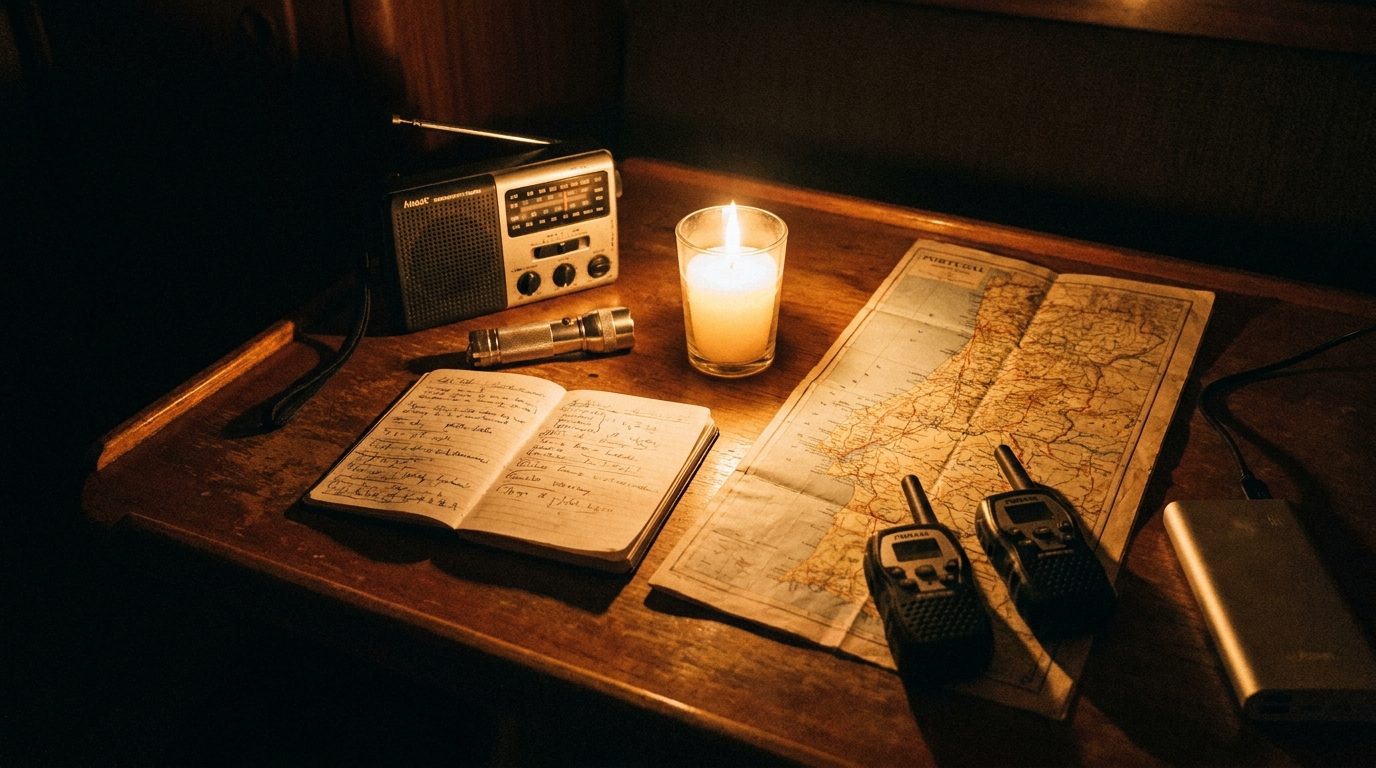
Emergency communication
When mobile networks and the internet fail, knowing how to communicate through alternative means can be decisive. This guide covers everything from SMS to radios and mesh networks.
In emergencies, communication can save lives
When networks fail, being prepared to communicate makes all the difference. Having tested alternatives and a family communication plan is just as important as having emergency water and food supplies.
Why networks fail
Overload
During emergencies, thousands of people try to call and send messages simultaneously. Mobile phone masts have limited capacity and quickly become saturated, making it impossible to place or receive calls.
Infrastructure damage
Earthquakes, storms, floods and wildfires can destroy or damage mobile phone masts, telecommunications towers, fibre optic cables and network equipment. Repairs can take days or weeks.
Power cuts
Telecommunications base stations depend on electricity. Backup batteries typically last 4 to 8 hours. Without mains power, the masts stop working and coverage disappears.
Communication levels
When networks fail, several alternatives exist, from the simplest to the most advanced. Ideally, you should be familiar with at least 2 or 3 of these methods.
1. SMS
Text messages work longer than voice calls because they use far less bandwidth. Even with a congested network, an SMS may get through when a call cannot.
- Lower bandwidth than voice calls
- Works even with a weak signal
- Prepare short messages with essential information
- Agree on codes with your family: "I'm safe" or "Need help"
2. FM/AM radio
Even without mobile networks or the internet, FM and AM radio broadcasts continue to work. They are the most reliable way to receive official information during emergencies.
- Antena 1: 95.7 FM (Lisbon), national coverage
- Official ANEPC emergency broadcast channel
- Keep a battery-powered or hand-crank radio in your kit
- Receive information only, not two-way
3. PMR446 walkie-talkies
Licence-free radios available from any electronics shop. Ideal for short-range communication with family and neighbours.
- No licence required in Portugal or the EU
- 16 channels on the 446 MHz frequency
- Maximum power 0.5W
- Typical range: 3 to 8 km (depends on terrain)
4. Amateur radio
With greater range than PMR446, amateur radios allow communication over tens or hundreds of kilometres. They require an ANACOM licence and a theory examination.
- ANACOM licence required (theory exam)
- Much greater range than PMR446
- Network of repeaters across Portugal
- Active community during emergency situations
5. Meshtastic / LoRa
A decentralised mesh network that works without the internet, without telecommunications towers and without fees. Each device acts as a repeater, extending the network's range.
- No internet, no fees, no licence required
- Affordable hardware: 25 to 50 euros per device
- Range: 5 km direct, up to 100+ km with repeaters
- Text messages and GPS location sharing
6. Visual and audible signals
When all electronics fail, visual and audible signals still work. They are the last line of communication and should be part of any emergency kit.
- Emergency whistle (3 short blasts = call for help)
- Signal mirror (visible for kilometres)
- Torch SOS signal (3 short, 3 long, 3 short)
- Smoke signals or improvised flags
PMR446 in Portugal
Licence-free radios
PMR446 (Private Mobile Radio) radios are licence-free in Portugal and across the European Union. They require no licence, registration or authorisation of any kind. They are the most accessible form of two-way communication in emergencies.
- Frequencies: 446.00625 to 446.19375 MHz, 16 analogue channels
- Maximum power: 0.5W ERP (equivalent to 500 mW)
- Typical range: 3 to 8 km in open terrain, less in urban or mountainous areas
- Legal: no licence required in Portugal and the EU
- Price: from around 20 euros per pair
Practical tips
- The whole family should have the same model of radio to ensure compatibility
- Agree in advance on the channel and sub-channel (CTCSS) to use in an emergency
- Regularly test the range in the area where you live
- Keep spare batteries or use rechargeable models
- Practise using the radios before you need them. An emergency is not the time to read the manual
Meshtastic for Portugal
Mesh network without the internet
Meshtastic is an open-source project that turns small LoRa radio devices into a decentralised mesh network. Messages hop from device to device until they reach their destination, without needing the internet, telecommunications towers or any centralised infrastructure.
What it is
- Mesh network using LoRa (Long Range) radio
- Works without the internet, without mobile networks, without monthly fees
- Each device automatically acts as a repeater
- Sends text messages, GPS location and telemetry
Recommended hardware
- Heltec V3: compact, OLED screen, 25 to 35 euros
- LILYGO T-Beam: built-in GPS, 18650 battery, 35 to 50 euros
- Frequency for Europe: 868 MHz (ISM band)
- Configuration via Meshtastic app (Android/iOS)
Range
- Direct: 5 km in urban areas, 10 to 20 km in open terrain
- With repeaters: up to 100+ km in a chain
- Solar-powered repeaters on high points dramatically extend coverage
Community in Portugal
- Active and growing community
- Node map at meshtastic.org
- Telegram and Discord groups for coordination
Family communication plan
Prepare before an emergency
A family communication plan should be prepared, written down and practised before any emergency occurs. Every family member should know the plan.
- Agree on a PMR frequency and channel: for example, channel 8, sub-channel 3. Everyone should know this by heart
- Set listening times: for example, at minute 0 and 30 of every hour. Switch on the radio, listen for 5 minutes, transmit if necessary
- Establish a primary meeting point: a location known to everyone, accessible on foot. For example: local school, church, central square
- Set an alternative meeting point: in case the primary one is inaccessible. For example: a relative's house, an open car park
- Emergency contacts on paper: keep phone numbers, addresses and names written on laminated paper. Do not rely solely on your mobile phone
- Out-of-area contact: designate a family member or friend outside the affected area as a central communication point
- Practise at least once per quarter: test the radios, review meeting points and update contacts
Off-grid charging
There is no point having radios and devices if you cannot charge them. These are the options for keeping your equipment operational without mains electricity.
Portable solar panel
- Recommended power: 10 to 20W
- Price: 30 to 50 euros
- Charges phones, radios and Meshtastic devices
- Works even on overcast days (reduced efficiency)
- Choose foldable models for your emergency kit
Large power bank
- Minimum recommended capacity: 20,000 mAh
- Enough for 4 to 6 full phone charges
- Keep it fully charged and in your emergency kit
- Models with built-in solar panels are useful but slow
- Check the charge level every 3 months
Hand-crank charger
- Last-resort reserve
- Always works, no dependence on sun or batteries
- Very slow charging (1 minute of cranking = a few minutes of use)
- Ideal for emergency FM radios with built-in crank
- Independent of weather conditions
Useful resources
- meshtastic.org - Meshtastic project (node map and documentation)
- anacom.pt - ANACOM (amateur radio licensing)
- rea.pt - Rede dos Emissores Portugueses (amateur radio association)
- All emergency contacts