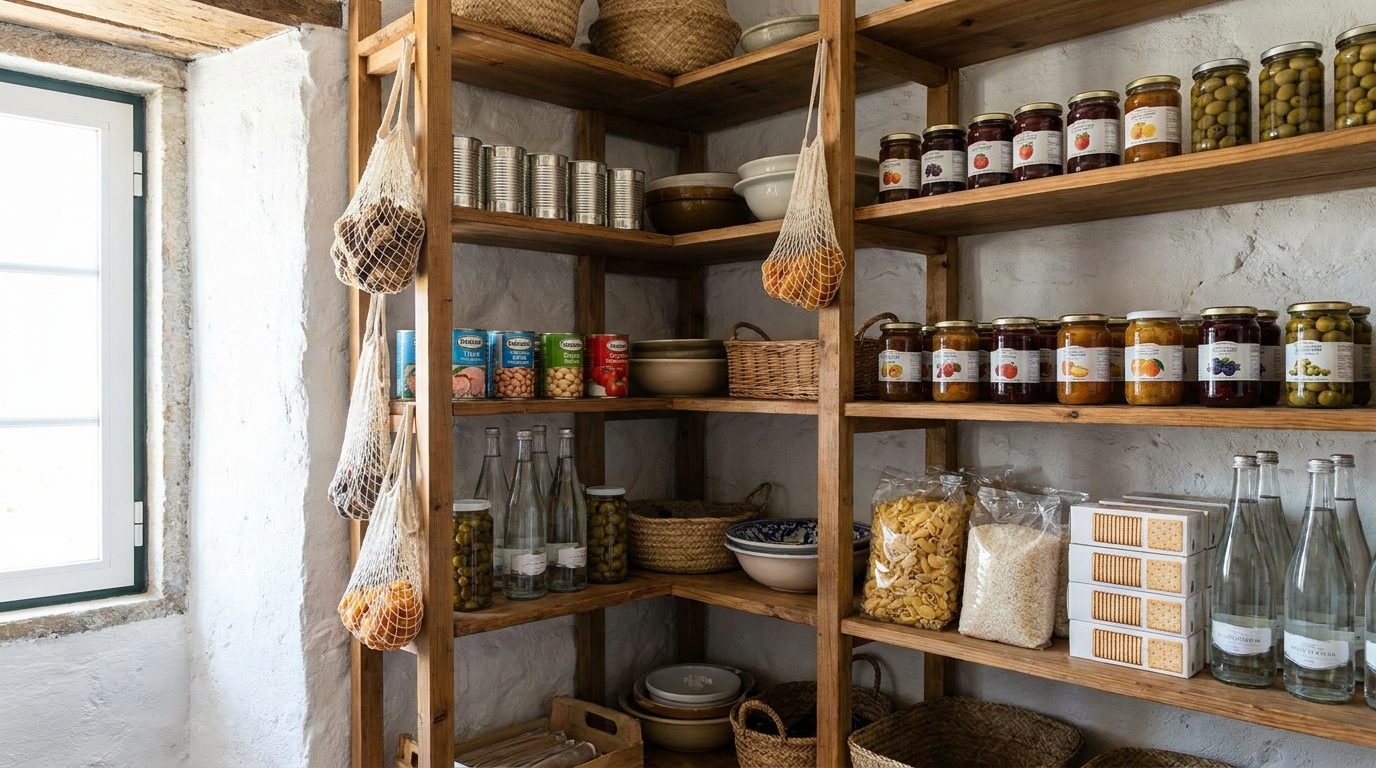
Complete emergency food supply
Emergency food: what to buy and store. Build a long-lasting food supply adapted to the Portuguese reality.
Short term: up to 1 week
This is the minimum supply every household should have. It focuses on ready-to-eat foods or items that require minimal preparation.
| Food | Quantity per person | Shelf life | Notes |
|---|---|---|---|
| Bottled water | 14-21 L | 1-2 years | Prefer sealed 5 or 6 L jugs. Essential for drinking and cooking |
| Canned tuna or sardines | 6-8 tins | 3-5 years | Essential protein, easy to eat. Vary between tuna in water and in olive oil |
| Canned pulses | 4-6 tins | 2-5 years | Chickpeas, beans, lentils. Fibre and plant-based protein |
| Crackers or plain biscuits | 3-4 packs | 6-12 months | Maria biscuits, wholemeal or crackers. Quick carbohydrates |
| Energy bars | 7-10 units | 6-12 months | Practical for transport and quick consumption |
| Dried fruit and nuts | 500 g | 6-12 months | Walnuts, almonds, raisins. Healthy fats and energy |
| UHT milk | 3-4 L | 6-9 months | Or powdered milk as a longer-lasting alternative |
| Instant soups | 5-7 units | 1-2 years | Only require hot water. Comfort and hydration |
| Jam or honey | 2 jars | 1-3 years | Quick energy. Honey has a virtually unlimited shelf life |
| Chocolate | 3-4 bars | 1-2 years | Important for morale and quick energy |
| Baby food | As needed | 1-2 years | Essential if you have young children |
Medium term: 1 month
For extended self-sufficiency, add basic ingredients that allow you to cook full meals. These products have excellent durability and a low cost per serving.
| Food | Quantity per person | Shelf life | Notes |
|---|---|---|---|
| Rice | 3-5 kg | 2+ years | Store in an airtight container. The base of many meals |
| Pasta | 3-5 kg | 2+ years | Vary the shapes: spaghetti, penne, fusilli |
| Flour | 2 kg | 1 year | For making basic bread or thickening sauces |
| Olive oil | 2 L | 1-2 years | A staple of Portuguese cooking. Store in a dark place |
| Salt and sugar | 1 kg each | Indefinite | Will not spoil if kept dry |
| Assorted canned goods | 20-30 tins | 2-5 years | Vary: meat, fish, vegetables, fruit in syrup |
| Dried pulses | 2-3 kg | 2+ years | Beans, chickpeas, lentils. Require soaking and cooking |
| Coffee or tea | 500 g or 50 teabags | 1-2 years | Psychological comfort is important during stressful situations |
| Powdered milk | 1 kg | 1-2 years | Lasts longer than UHT milk. Reconstitutes easily |
| Tomato sauce | 4-6 tins | 1-2 years | Base for pasta sauces and other dishes |
Emergency cooking equipment
Without electricity or mains gas, you will need alternative equipment for cooking. Here are the most practical and affordable options available in Portugal.
Portable camping gas stove
15-25 EUR
Uses CV470 butane cartridges (standard fitting). One cartridge lasts approximately 1 hour 30 minutes on medium heat. For one week, you need 4-6 cartridges. Common brands: Campingaz Bistro, NJ-100. Lightweight, compact and easy to use. Perfect for extended emergency situations.
Where to buy: Decathlon (~18 EUR), Leroy Merlin, AKI, Continente, Sport Zone
CV470 butane gas cartridges
2-3 EUR each (pack of 4: ~8-12 EUR)
Compatible with most portable camping stoves. Store away from heat sources and direct sunlight. Do not use at temperatures below 5 degrees C (reduced performance). Always keeping 8-12 cartridges in stock ensures several weeks of self-sufficiency.
Where to buy: Decathlon, Leroy Merlin, Auchan, Continente
Alcohol or wood-burning stove (alternative)
15-30 EUR
Trangia-type or rocket stove. Does not depend on cartridges. Runs on ethyl alcohol, firewood or pine cones. Ideal as a backup for those with access to firewood or living in rural areas. Slower than gas but completely self-sufficient.
Where to buy: Amazon.es, Decathlon, specialist camping shops
Manual tin opener
3-5 EUR
ESSENTIAL. Without electricity, electric tin openers will not work. Buy two and store them in different places. Choose sturdy stainless steel models. This is the most forgotten and most needed item when you have dozens of tins to open.
Where to buy: Any supermarket, Ikea, euro shops
Camping cookware set
15-30 EUR
Pot + frying pan + lid in aluminium or stainless steel. Compact and stackable. Often includes a folding handle. Optimised for use with a portable stove. Lightweight and easy to clean with minimal water.
Where to buy: Decathlon (~15 EUR), Amazon.es, Sport Zone
Insulated cool box
15-40 EUR
To keep food cold during power cuts. With pre-frozen ice packs, it maintains cold for up to 24-48 hours. Recommended capacity: 25-40 L for a family of 4. Essential if you have medication that requires refrigeration.
Where to buy: Decathlon, Leroy Merlin, hypermarkets