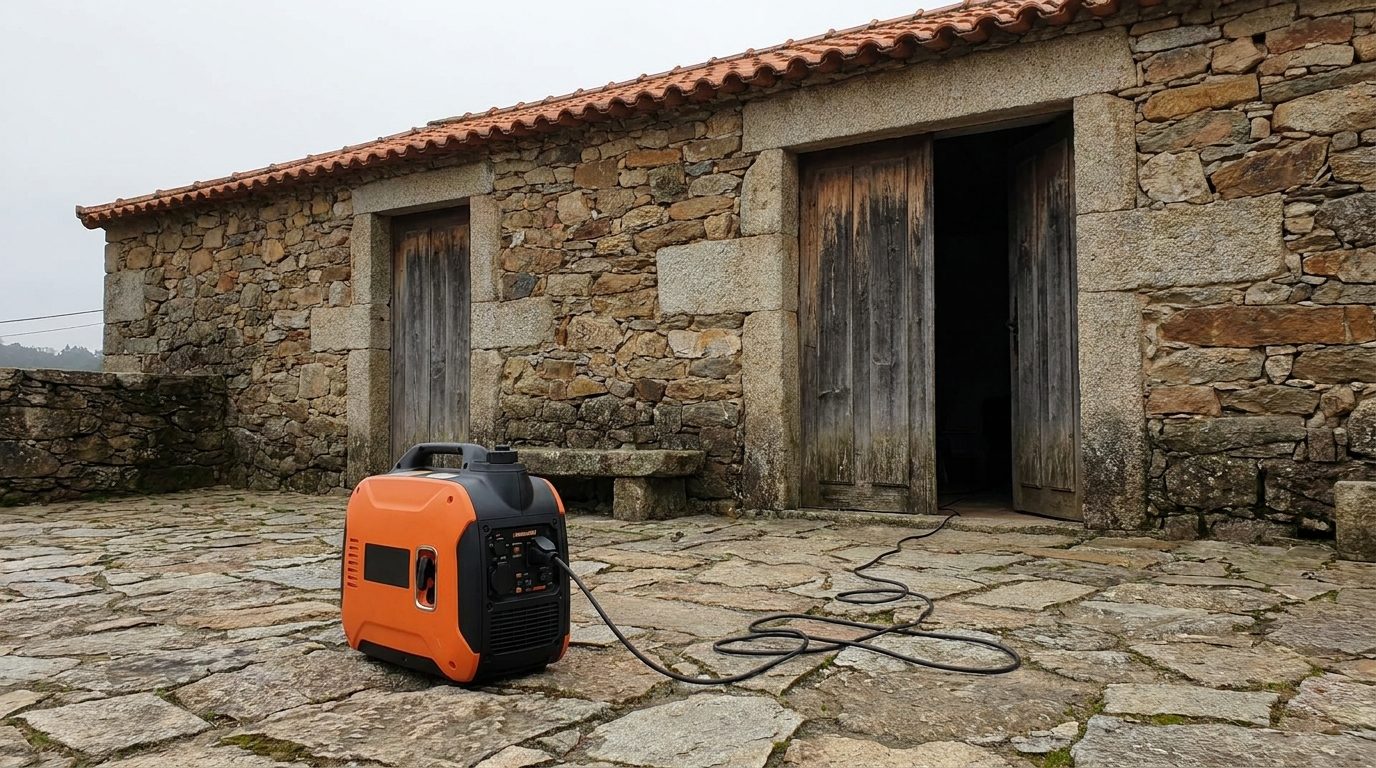
Generator calculator
WARNING: Carbon monoxide kills
NEVER use generators indoors, in a garage, enclosed balcony or any closed or semi-enclosed space. Carbon monoxide (CO) is invisible, odourless and kills within minutes. Always keep the generator at least 6 metres from any window, door or ventilation opening.
Select the appliances you need to power
Generator buying guide
Generator types explained
- Inverter generator: Produces clean, stable power. Safe for sensitive electronics (phones, laptops). Much quieter (53-59dB). Economical (adjusts RPM to load). More expensive, but well worth it for home use.
- Conventional generator: More powerful and cheaper, but very loud (90-100dB). Can damage sensitive electronic equipment. Always burns fuel at maximum rate. Best for tools and pumps.
- Dual-fuel generator: Runs on petrol or butane/propane gas. More versatile in emergencies. Gas stores better than petrol (does not degrade).
Recommended inverter generators
Honda EU10i (1000W)
The best portable generator. Extremely quiet (53dB), reliable, economical (4L last 8h). Weight: 13kg. Perfect for fridge + lighting + phones.
Honda EU22i (2200W)
More power, same Honda quality. 59dB, 3.6L last 8h. Can connect 2 in parallel (4400W). Ideal for a whole house. Weight: 21kg.
Briggs & Stratton P2400 (2400W)
Affordable alternative. Inverter, 59dB, good value for money. 7.5L last 10h. Reliable American brand.
Hyundai HY2000Si (2000W)
Budget-friendly option. Inverter, 65dB (acceptable). Lower quality than Honda but gets the job done. 4.5L last 5h.
Conventional generators (more powerful)
Conventional generator 3500W
High power, low price. Very loud (95dB). Suitable for tools, water pumps, heaters. Do not connect sensitive electronics directly.
Champion dual-fuel 3500W
Petrol or propane/butane gas. Flexibility in emergencies. Electric start. 90dB. Runtime: 16h on petrol, 10h on gas (13kg bottle).
Power stations (silent indoor alternative)
EcoFlow River 2 (256Wh, 300W)
Ideal for phones, laptop, lighting, CPAP. Weight 3.5kg. Charges in 1h. Compatible with solar panel (110W, +€150). SAFE to use indoors.
Jackery Explorer 500 (518Wh, 500W)
More capacity. Can run a fridge for several hours. 6kg. Solar charging (100W, +€200). Very reliable.
Bluetti EB3A (268Wh, 600W)
Excellent value for money. 600W peak 1200W. Fast charging in 1h. UPS mode (automatic switchover if power goes out). Solar panel +€180.
EcoFlow Delta 2 (1024Wh, 1800W)
Serious power station. Runs a fridge for 10-15h, microwave, tools. Expandable up to 3kWh. 400W solar panel. For those who want real autonomy.
Anker 757 (1229Wh, 1500W)
LiFePO4 battery (lasts 3000 cycles = 10 years). Long-term investment. Very reliable. 300W solar charging.
Solar panels for power stations
If you buy a power station, consider a portable solar panel (100-200W, €150-300). During a prolonged emergency, you can recharge during the day and use it at night. Brands: EcoFlow, Jackery, Bluetti, Allpowers. Look for a panel compatible with your power station (same connector or with adapter).
Fuel and storage
Petrol safety
- Approved fuel cans: Use only approved fuel containers (metal or red plastic). Never use water bottles or other containers. 10L (~€15-25, Leroy Merlin, AKI).
- Petrol stabiliser: Petrol degrades in 3-6 months (forms varnish, clogs carburettor). Use Sta-Bil or Briggs & Stratton Fuel Stabilizer (~€12/250ml treats 95L). Always add when storing. Where: Leroy Merlin, Amazon.es, marine supply shops.
- Quantity: For 1 week: minimum 20-30L. Honda EU10i consumes 0.5L/h, EU22i 0.45L/h.
- Where to store: NEVER inside the house. Ventilated garage, outdoor storage shed, away from heat sources and sparks. Cool, shaded area.
- Rotation: Use and replace every 6-12 months (even with stabiliser). Put it in the car, refill with fresh petrol.
Recommended maintenance products
Sta-Bil Storage Fuel Stabilizer
Keeps petrol fresh for 24 months. 30ml treats 38L. Essential. Always use it.
Approved fuel can 10L
Metal (safer) or approved plastic. Buy 2-3. Red = petrol.
Oil + spark plug kit
10W-30 or synthetic oil (Honda recommended). NGK or Champion spark plug. Replace annually or every 50h of use.
Essential maintenance
Maintenance routine (or your generator will not start when you need it)
- Monthly: Start the generator and let it run for 15-20 minutes under load (plug something in). This lubricates the engine, charges the battery (if it has electric start) and prevents the carburettor from clogging.
- Annually or every 50h of use: Change engine oil (first oil change at 5h, then every 50h or annually). Replace spark plug. Clean air filter.
- Before a storm: 24-48h beforehand, start and test at full load for 1-2h. Fill the tank. Confirm fuel cans are full.
- Carburettor: If it will not start after months sitting idle, the carburettor is likely clogged (varnish from old petrol). Prevention: use stabiliser + start monthly. Repair cost: €50-150 (carburettor cleaning).
Cables and electrical safety
Extension leads and connections
- Thick cables: Use 2.5mm² extension cables (up to 2000W) or 4mm² (up to 3500W). Thin cables overheat, melt and catch fire. Maximum 25m. Where: Leroy Merlin (€30-80).
- Transfer switch: If you want to connect a generator to your home's electrical panel, you MUST install a transfer switch (€150-400 + electrician). This prevents the generator from back-feeding the grid (which can kill utility workers). It is illegal and dangerous without a transfer switch.
- Grounding: Generators need an earth connection (grounding rod). Especially important for inverters and electronics. 1.5m copper grounding rod (~€15-25, Leroy Merlin).
- Protection: Always use an RCD/residual current device (30mA). Many generators already have one built in. Check yours.
Generator buying checklist
- ✓ Inverter generator (if budget allows) or conventional
- ✓ 2-3 approved 10L fuel cans
- ✓ Petrol stabiliser (Sta-Bil)
- ✓ 30-50L of petrol (replace every 6-12 months)
- ✓ Spare engine oil (2L)
- ✓ Spare spark plugs (2 units)
- ✓ Heavy-duty extension cable (2.5-4mm², 15-25m)
- ✓ Grounding rod
- ✓ Instruction manual (read BEFORE an emergency)
- ✓ Test monthly