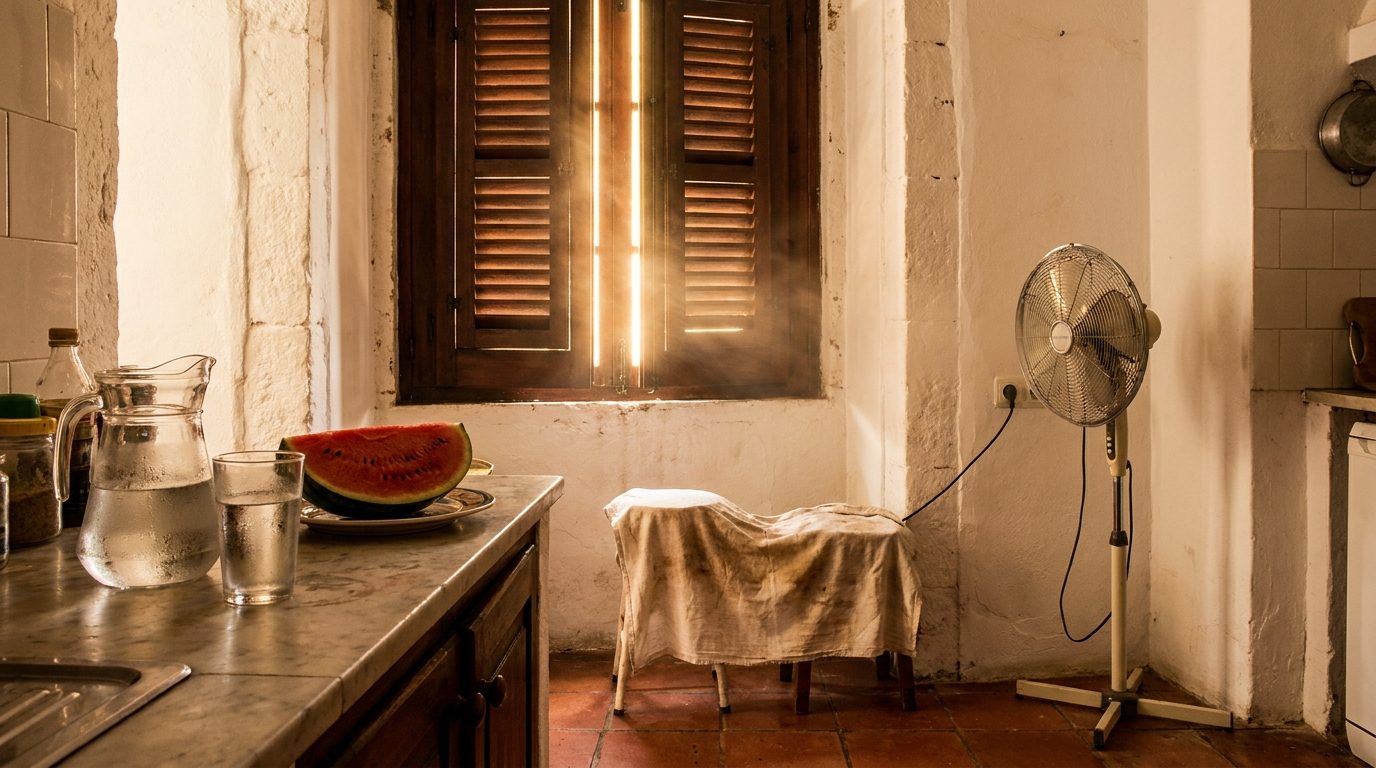
Heat waves
Portugal experiences increasingly frequent and intense heat waves. Temperatures above 40°C are common in the interior and can be fatal, especially for the elderly and young children.
Heat kills silently
In 2023, Portugal recorded over 1,000 excess deaths attributed to heat. The elderly are the most vulnerable group. Many die alone at home without air conditioning. A heat wave is a public health emergency. Check IPMA alerts for temperature warnings.
Heat domes: the new Portuguese reality
What a heat dome is
A heat dome is an area of extremely high pressure that settles over a region for several days, pressing hot air downwards and stopping it from circulating. The effect is like a closed oven: temperatures rise day after day, and night brings no relief because the hot air does not escape.
Portugal has been recording heat domes increasingly early, with temperatures close to 40°C already in May in some events over the last decade — several weeks before the traditional July/August peak. These episodes have shifted from "rare" to recurring.
Why it is more dangerous than a normal heatwave
- No night-time relief: the body does not recover overnight (minimums above 25°C)
- Lasts 5-14 days: mortality climbs sharply after the 3rd consecutive day
- Portuguese homes cope badly with heat (built for the cold, not the heat — without proper insulation)
- Electrical overload: blackouts from excessive AC use
- Wildfires in parallel: dry air and wind
- Drought makes it worse: low rivers and wells, livestock affected
Warning sign: tropical nights
When the night-time minimum temperature does not drop below 20°C (a tropical night) or 25°C (a torrid night), the risk to the elderly and the chronically ill rises sharply. Without night-time relief, the body cannot cool down between days. These are the nights when checking on the most vulnerable saves lives.
At-risk groups
Very high risk
- Elderly (over 65): reduced thermoregulation, diminished sense of thirst
- Babies and young children (under 5): dehydrate rapidly
- Chronic illness: cardiovascular, renal, diabetes, respiratory conditions
- Bedridden individuals: unable to seek cooler environments
High risk
- Outdoor workers: construction, agriculture, waste collection
- People exercising outdoors
- Obese individuals: greater difficulty dissipating heat
- Homeless people: no access to shelter or water
Check on your neighbours
- Visit elderly people living alone at least twice a day
- Make sure they drink water regularly
- Take them to cool spaces if they do not have air conditioning
- Check their medication, it may need adjusting (see guide)
Heat stroke vs Heat exhaustion
Heat exhaustion
Severity: Moderate, needs attention
- Heavy sweating
- Cool, clammy skin
- Weakness, dizziness, nausea
- Headache
- Muscle cramps
- Rapid but weak pulse
What to do
- Move the person to a cool, shaded place
- Lie them down with legs elevated
- Give cool water in small sips (not ice-cold)
- Apply damp cloths to forehead, back of neck, and wrists
- If no improvement within 30 minutes, call 112
Heat stroke
Severity: MEDICAL EMERGENCY, can be fatal
- Body temperature above 40°C
- Hot, red, and DRY skin (no sweating)
- Confusion, delirium
- Loss of consciousness
- Seizures
- Rapid and strong pulse
CALL 112 IMMEDIATELY
- Cool URGENTLY: cold water on the body, ice packs on armpits, groin, and back of neck
- Move to shade, remove clothing
- DO NOT give water if the person is unconscious
- Place in the recovery position if unconscious
- Continue cooling until INEM (emergency medical service) arrives
How to protect yourself
Hydration
- Drink 2-3 litres of water per day even if you are not thirsty
- Avoid alcohol, coffee, and sugary drinks (they dehydrate)
- Eat water-rich fruit: watermelon, melon, oranges, cucumber
- Cold soups (gazpacho) and salads
- Avoid heavy, hot meals
- Children and elderly: offer water every 20-30 minutes
Behaviour
- Avoid sun exposure between 11:00 and 17:00
- Lightweight, light-coloured, loose clothing (cotton or linen)
- Wide-brimmed hat and sunglasses
- Sunscreen SPF 50+ (reapply every 2 hours)
- Cool baths or showers (not ice-cold)
- Exercise: only early morning or late evening
- NEVER leave children or animals in a car
Protecting your home
- Close shutters and blinds on the sunny side
- Ventilate at night and early morning (open windows)
- Close windows in the morning as the temperature rises
- Hang damp cloths in front of fans
- If you do not have AC: spend the hottest hours in an air-conditioned public space (shopping centre, library)
- Plants outside south-facing windows provide natural shade
Pets
- Fresh water always available and in the shade
- NEVER walk dogs on hot tarmac (test: if you cannot hold your hand on the ground for 5 seconds, it is too hot for their paws)
- Walks only early morning or in the evening
- Signs of heat stroke in dogs: excessive panting, thick drool, disorientation
- Cats: ensure access to cool rooms
- See the full guide for pets
Medications affected by heat
Medication caution during heat waves
Some medications are affected by heat or alter the body's response to heat. Consult your doctor before changing any medication.
- Diuretics: increase water loss, higher risk of dehydration
- Beta-blockers: reduce the heart's ability to adapt to heat
- Antihistamines: can reduce sweating
- Antidepressants: some affect thermoregulation
- Antipsychotics and anticholinergics: block sweating — high risk of hyperthermia
- NSAIDs (ibuprofen, naproxen): place extra strain on the kidneys when dehydrated
- Insulin: degraded by heat. Store in a cool place (2-8°C), never in the car
- Storage: most medications should be kept below 25°C. If your home exceeds this, store them in a cooler spot (not in the fridge unless indicated)
- See the medical kit guide for storage advice
Insulin and the home cold chain
About 1 million people in Portugal have diabetes, and hundreds of thousands use insulin every day. In a heatwave with a long blackout or a broken fridge, keeping the cold chain intact becomes a matter of survival.
Insulin — essential rules
- Unopened (sealed vial/pen): 2-8°C (fridge), until the expiry date
- In use (opened pen): can stay at room temperature up to 25-30°C for 28 days (check the leaflet — variants such as Lantus and some analogues have their own rules)
- Above 30°C or in direct sunlight: loses effectiveness, discard
- NEVER freeze: the molecule's structure is destroyed — useless even if thawed
- NEVER leave in the car (interior temperatures reach 60-70°C in summer)
- When travelling, use a medication cool pouch
Other refrigerated medications
- GLP-1 (Ozempic, Saxenda, Trulicity): ideal at 2-8°C; once opened, withstands up to 30°C for 28-56 days (check the leaflet)
- Vaccines (kept at home, e.g. for campaigns): always 2-8°C — use a fridge thermometer
- Adrenaline (EpiPen, Anapen): 15-25°C — do not refrigerate (cold also degrades it). Cloudy or yellowish liquid = discard
- Eye drops once opened: some need refrigeration (check the leaflet)
- Antibiotics in suspension (paediatric, once reconstituted): usually 2-8°C, 7-14 days
- Thyroid hormones and oral contraceptives: below 30°C is enough, no fridge needed
Without a fridge (blackout or breakdown)
- Closed fridge: stays safe for about 4 hours
- Cool pouch + ice packs (supermarket cool bag): holds 4-8°C for 12-24 hours
- Do not place insulin in direct contact with ice (risk of freezing): wrap it in cloth or a tea towel
- Frozen 1.5-litre bottles work as homemade ice packs
- Large camping cool box + 2-3 eutectic plates: 24-48 hours at 4-10°C
- Neighbour/friend with a generator or power: move refrigerated medication there
Cooling without electricity — the zeer pot method
An ancient evaporative cooling technique that needs no power. Keeps things 5-10°C below the ambient temperature:
- 2 clay pots: 1 larger, 1 smaller that fits inside with 3-5 cm clearance
- Fill that gap with damp sand
- Cover the inner pot with a damp cloth
- Keep in the shade, in a breeze, off the ground
- Wet the sand 1-2 times a day
- Useful for food, vegetables, eggs and non-refrigerated medication
- Does not replace a fridge for insulin — only a partial alternative
Plan for people with diabetes during a heatwave
- Before summer: buy 1 cool box and 4-6 eutectic plates, keep them in the freezer
- At the start of the heatwave: move open insulin to the coolest spot in the house (usually a north-facing kitchen or an inner pantry). Use a digital thermometer with a sensor
- 7-day reserve of insulin + lancets + test strips + meter — keep them in a cool place
- Reinforced hydration: dehydration sends blood sugar out of control
- Check more often: heat changes insulin absorption (it becomes faster)
- A plan with SNS 24 or your family doctor: a direct line for a crisis
Contacts
Emergency
- 112, Emergency
- E-REDES (power outages): 800 506 506
- SNS 24 (health line): 808 24 24 24
Alerts
- IPMA (weather and geophysics institute): ipma.pt
- IPMA alerts guide
- IPMA app (temperature alerts)
Support
- Linha do Idoso (elderly helpline): 800 203 531
- ANEPC (Civil Protection): 800 246 246
- All contacts
Plan ahead
When IPMA (the Portuguese Institute for Sea and Atmosphere) issues an orange or red heat alert, prepare the day before: buy extra water, check on elderly family members and neighbours, plan activities at cool locations. Extreme heat can last 5-10 days. Prepare for a prolonged period, not just a single day.