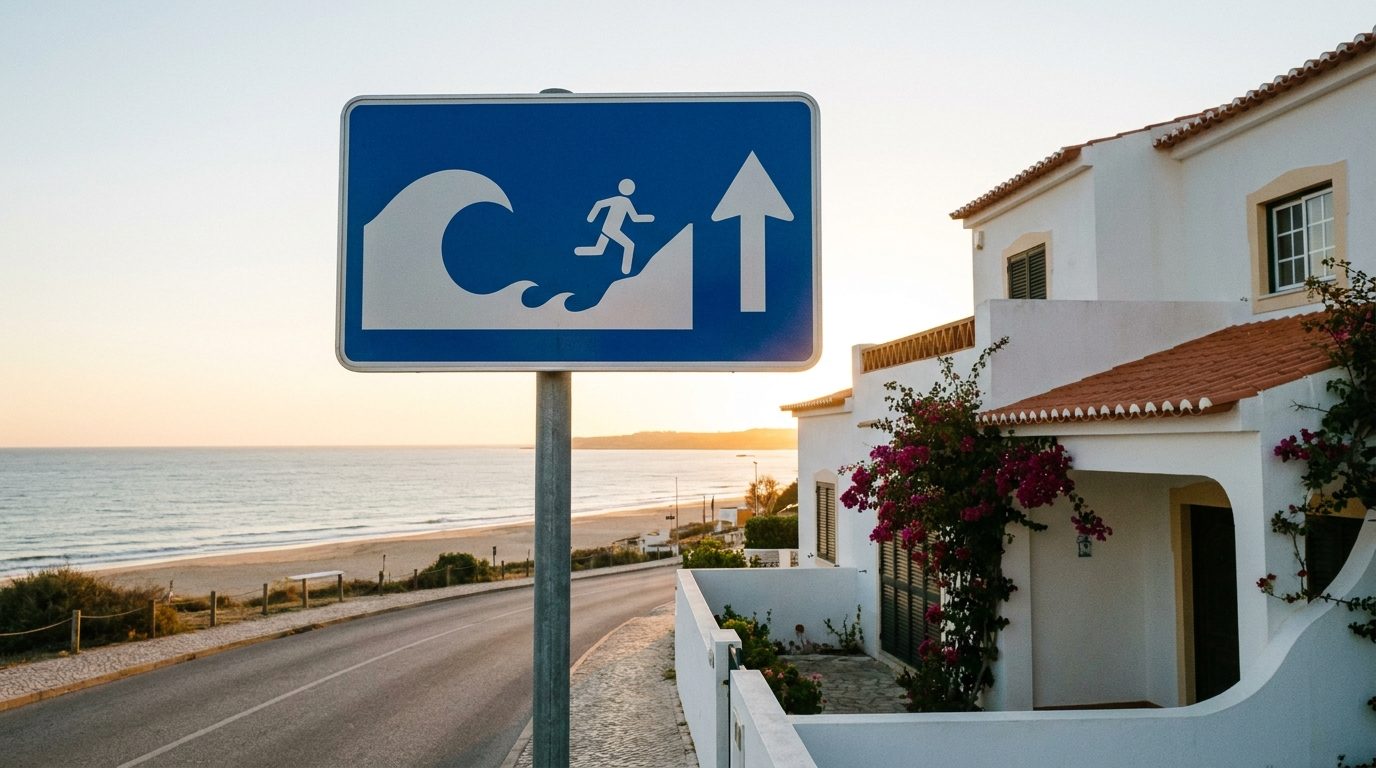
Tsunamis in Portugal
The Portuguese Atlantic coast is vulnerable to tsunamis generated along the Azores-Gibraltar fault. The 1755 tsunami devastated Lisbon, the Algarve, and parts of the western coast.
Felt a long or strong earthquake near the coast? Head to high ground IMMEDIATELY
Do not wait for an official alert. If you are on the coast and feel an earthquake lasting more than 20 seconds or strong enough to make you lose your balance, move away from the coast to high ground immediately (at least 30 metres above sea level or 2 km inland). The earthquake IS your natural warning. A tsunami can arrive within 15 to 60 minutes.
Tsunami risk in Portugal
Why Portugal?
- Azores-Gibraltar Fault: contact zone between the Eurasian and African tectonic plates
- 1755 Earthquake: magnitude ~8.5-9.0, generated a tsunami with waves of 5-15 metres that struck Lisbon, the Algarve, Cadiz, and even northern Europe
- Tsunamis also hit Portugal in 1531, 1722, and 1969 (smaller)
- Estimated recurrence period for a major tsunami: 200-1,000 years
- Low probability, extreme consequences. Being prepared is essential
Vulnerable coastal areas
- Algarve: greatest direct exposure to the fault, flat beaches, high tourist concentration
- Lisbon coast: low-lying Tagus area (Terreiro do Paco, Belem, Cais do Sodre)
- Setubal and Troia: low-lying coastal zones
- Western coast: Peniche, Nazare, Figueira da Foz
- Azores: local seismic and volcanic risk
- Any area less than 30 m above sea level and less than 2 km from the coast
Natural warning signs
Recognising the signs can save your life
- Strong earthquake on the coast: the most important sign. If you feel an earthquake lasting more than 20 seconds or that makes it difficult to stand, EVACUATE the coast immediately
- Abnormal sea withdrawal: if the sea recedes much further than normal, exposing seabed that is usually submerged, a tsunami is on its way (minutes)
- Unusual noise: a sound like a train or aeroplane coming from the sea
- Animal behaviour: animals fleeing from the coast
Do not wait for an official alert
The IPMA (Portuguese meteorological institute) tsunami warning system may take 5-15 minutes to issue a warning. If the tsunami originates nearby (Azores-Gibraltar fault), waves can reach the Algarve coast within 15-30 minutes. The earthquake is your first and best warning. Act immediately.
BEFORE: How to prepare
If you live or work on the coast
- Know the altitude of your home or workplace above sea level
- Identify evacuation routes to high ground (on foot, not by car)
- Practise the route with your family. You should be able to reach high ground in under 15 minutes
- Identify tall reinforced concrete buildings as an alternative refuge (minimum 3rd floor)
- Emergency kit by the door (see emergency bag)
Family planning
- Meeting point on high ground
- Every family member knows the evacuation route
- Plan for children at school (coastal schools should have a tsunami plan)
- Know what to do if the family is separated (family plan)
- Teach children the rule: "Earthquake at the beach = run to high ground"
DURING: What to do
If you are on the coast
- After a strong earthquake: go to high ground immediately. Do not wait
- If you see the sea withdraw: run to high ground IMMEDIATELY
- Go on foot. Traffic blocks roads during evacuation
- Climb to at least 30 metres above sea level or move 2 km inland
- If you cannot reach high ground: go up a tall reinforced concrete building (3rd floor or higher)
- Take whatever is at hand (mobile phone, keys) but DO NOT waste time gathering belongings
If you are at sea or on the beach
- On the beach: evacuate immediately to high ground, moving perpendicular to the coast
- In a boat in the harbour: if there is time, head out to open sea (a tsunami in deep water is imperceptible; the danger is at the coast)
- In a boat near the coast: if there is no time to reach open sea, abandon the boat and head for high ground
- Swimming or surfing: get out of the water immediately and head for high ground
A tsunami is NOT a single wave
A tsunami consists of multiple waves that can arrive 10-60 minutes apart. The first wave may not be the largest. Stay on high ground for at least 2-3 hours, or until the authorities give the all-clear. DO NOT return to the coast out of curiosity.
AFTER: Recovery
Immediate safety
- Stay on high ground until official confirmation that it is safe
- Follow updates via radio or mobile phone
- DO NOT return to the coastal area to check damage
- Be aware of aftershocks that could generate another tsunami
- Call 112 only for real emergencies
- Contact family by SMS (less network congestion)
After the all-clear
- Tsunami floodwater is contaminated (salt, sewage, debris, fuel)
- DO NOT drink tap water until safety is confirmed
- Check building structure before entering
- Watch out for power lines, gas leaks, and unstable debris
- Photograph damage for insurance
- Follow ANEPC (Civil Protection) instructions for support
Warning system in Portugal
IPMA: National Tsunami Centre
- Portugal is part of the Northeast Atlantic tsunami warning system (NEAMTWS, UNESCO)
- IPMA (Portuguese Institute for Sea and Atmosphere) is the responsible national body
- 24/7 seismic monitoring
- Warning issued within minutes of detecting a potentially tsunamigenic earthquake
- Alerts disseminated via ANEPC (Civil Protection), IPMA, and the media
How to receive alerts
- IPMA app: automatic seismic alerts
- ANEPC (Civil Protection) app: location-based alerts
- Radio: Antena 1 for official information
- Sirens: some coastal areas may have warning sirens
- Remember: DO NOT rely solely on official alerts. The earthquake is your first warning
Contacts
Emergency
- 112: Emergency
- ANEPC (Civil Protection): 800 246 246
- SNS 24 (health line): 808 24 24 24
Monitoring
- IPMA Seismology: ipma.pt
- IPMA tide gauges: sea level monitoring
Information
Tourists and visitors on the coast
If you are holidaying on the Portuguese coast, learn the rule before you go to the beach: earthquake on the coast = head for high ground immediately. Identify high points near the beach where you are staying. Teach the rule to children. It takes 2 minutes of preparation that could save lives.