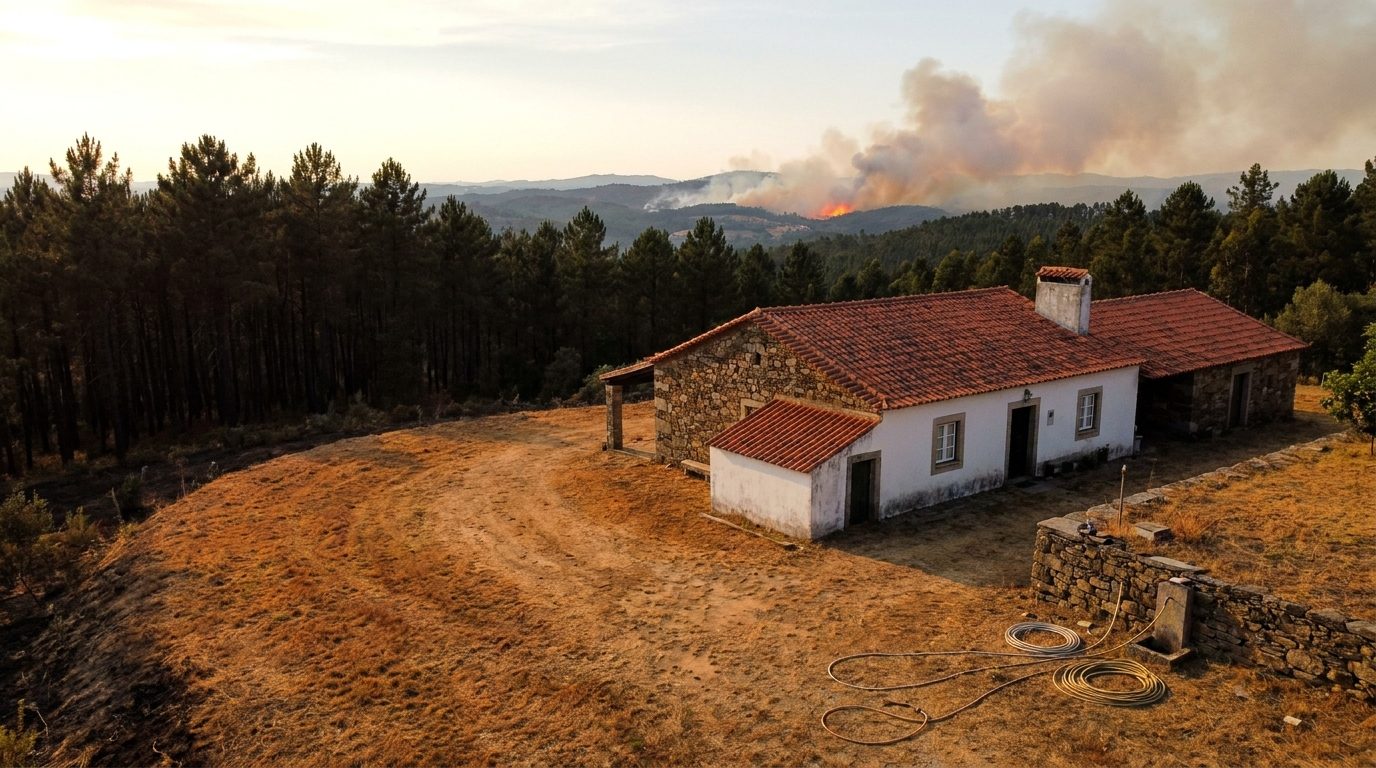
Wildfires in Portugal
Portugal is the European country most affected by wildfires. Every summer, thousands of hectares burn. Being prepared can save lives.
The lesson of Pedrógão Grande
In June 2017, the Pedrógão Grande wildfire killed 66 people and injured over 200. Many victims were caught on the roads while trying to flee by car. Having an evacuation plan and knowing the warning signs can be the difference between life and death.
Highest risk zones in Portugal
Very high risk
- Central interior: Pedrógão, Castelo Branco, Covilhã, Sertã
- Northern interior: Trás-os-Montes, Viseu, Vila Real, Monchique
- Areas dominated by eucalyptus and pine
- Steep terrain
- Isolated villages with few access roads
Critical period
- June to September: official high-risk period
- Especially dangerous with temperatures above 35°C and humidity below 30%
- Strong wind (above 30 km/h) accelerates fire spread dramatically
- Tropical nights (above 20°C) prevent vegetation recovery
- Check IPMA alerts daily during summer
BEFORE: How to prepare
Land clearing (required by law)
Decree-Law no. 82/2021 (Decreto-Lei n.º 82/2021) requires fuel management within a 50-metre buffer around buildings and 100 metres around villages. The annual deadline is 30 April.
- Cut brush and grass within 50m of the house
- Remove dead branches and dead trees
- Prune branches up to 4m in height (prevents crown-to-crown fire spread)
- Space trees apart: minimum 4m between canopies
- Clean gutters and roofs of leaves and pine needles
- Fine for non-compliance: €500-€5,000 (individuals) to €2,500-€25,000 (companies)
- The Local Council (Câmara Municipal) can carry out the clearing and charge the landowner
Preparing your home
- Garden hose long enough to reach the full perimeter
- External water tank (1,000L+) with a motor pump if possible
- Close ventilation openings with fine metal mesh
- Wooden shutters: treat with fire-retardant varnish
- Do not store firewood against the house
- Gas bottles: keep away from the house and protected
- Have an ABC fire extinguisher and fire blanket at home
Evacuation plan
- Two escape routes: never depend on a single road
- Practise the routes with the whole family
- Set a meeting point outside the risk zone
- Emergency bag near the door (see guide)
- Include pets in the plan (see guide)
- Include elderly people and those with reduced mobility: who will transport them?
- Important documents in a waterproof pouch, ready to take
DURING: What to do
If the fire is approaching
- If there is time to evacuate safely: EVACUATE IMMEDIATELY
- Call 112, give your exact location and the direction of the fire
- Wear long-sleeved cotton clothing, long trousers, boots
- Protect your airways with a damp cloth
- Take your emergency bag, documents, phone, water
- Close all windows, doors, and shutters when leaving (delays the fire)
- Turn off gas and electricity
If you are surrounded by fire
- DO NOT flee by car on a road surrounded by fire. Dense smoke causes zero visibility and heat can blow out tyres or ignite the fuel tank
- If you are in a solid house: it may be safer to stay inside with everything closed
- Fill the bathtub and buckets with water
- Place damp towels under doors
- Move away from the walls facing the fire
- Wait for the fire front to pass (it may take 5-15 minutes)
If you are outdoors
- Look for an area without vegetation: tarmac road, ploughed field, rocky ground
- Look for a body of water: river, lake, swimming pool
- NEVER run uphill. Fire moves uphill faster than any person
- Run perpendicular to the direction of the fire
- If caught: lie face down on the ground, protect your head
- Smoke kills more than flames. Stay low
AFTER: Recovery
First hours
- Watch for reignitions: embers can reignite hours or days later
- Do not enter burnt areas without authorisation from the fire service
- Check the structure of the house before entering
- Ash can contain toxic substances. Wear a mask and gloves
- Check whether the tap water is contaminated
- Beware of burnt trees, which can fall without warning
Air quality
- Wildfire smoke causes serious respiratory problems
- At-risk groups: people with asthma, elderly, children, pregnant women
- Keep windows closed, use an air purifier if possible
- FFP2/FFP3 mask outdoors
- Check air quality at qualar.apambiente.pt
- If you experience respiratory symptoms: call SNS 24 (health line) at 808 24 24 24
Relevant contacts
Emergency
- 112: Emergency
- 117: SOS Forest line (ICNF, the nature conservation institute)
- ANEPC (Civil Protection): 800 246 246
Enforcement
- GNR/SEPNA (environmental police): 808 200 520
- ICNF: icnf.pt
- Local Council (Câmara Municipal) for land clearing
Post-fire support
- Social Security: 300 502 502
- Local Council (Câmara Municipal) for local support
- All contacts
Prevention is everyone's responsibility
Over 95% of wildfires in Portugal are caused by humans: careless burning, poorly extinguished cigarettes, use of machinery on high-risk days. On maximum risk days, do not carry out burns, do not use angle grinders outdoors, and report dangerous behaviour to 112 or 117.