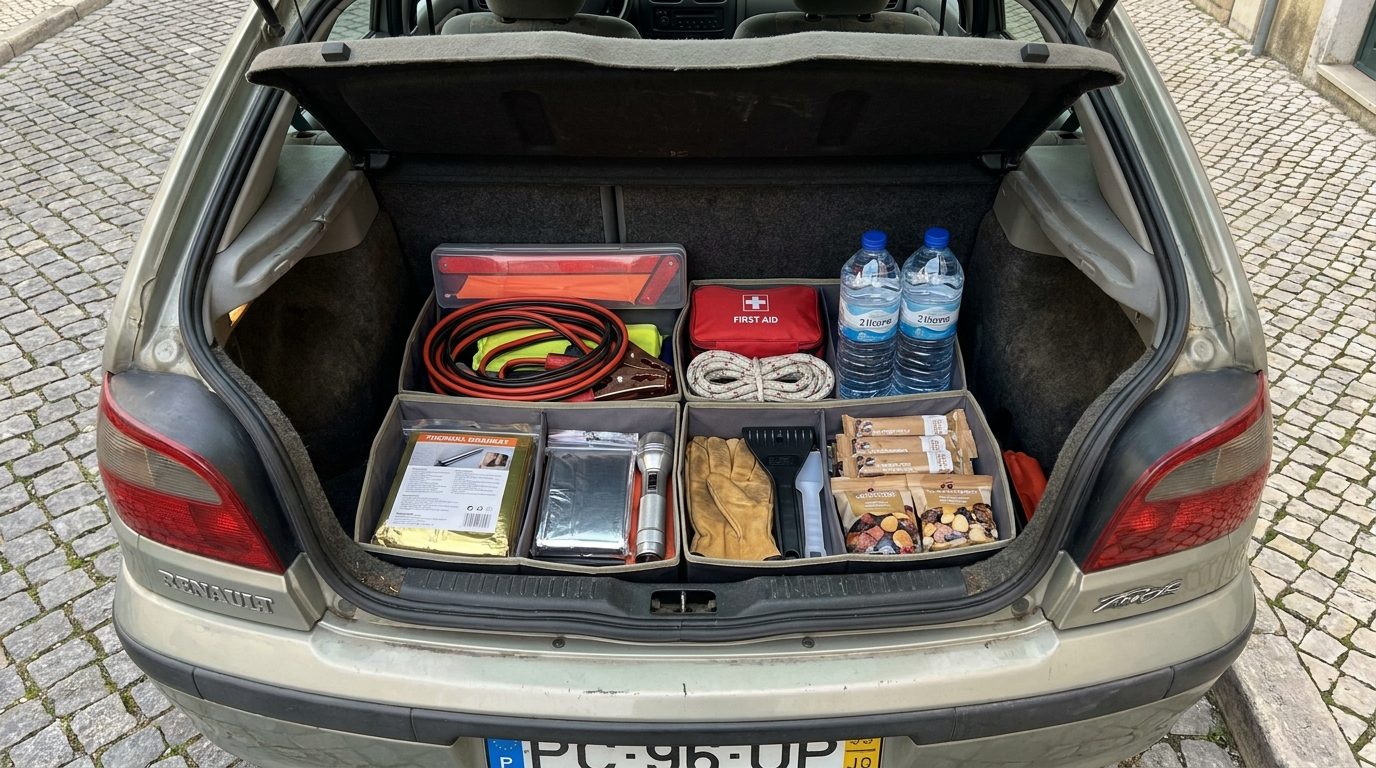
Car emergency kit
A car emergency kit can be essential when you get stranded due to a blocked road, snow, flooding or a breakdown. Items required by Portuguese law and extras that can make a real difference.
Why keep a kit in the car?
During Storm Kristin, thousands of drivers were stranded on roads blocked by flooding or fallen trees, some for hours. In winter, snow blocks roads in Serra da Estrela and other inland areas. Having the essentials in your car can mean the difference between comfort and danger.
Items required by law
Mandatory under the Portuguese Highway Code
- Warning triangle: approved, in good condition (EUR 5-15)
- Reflective vest: at least 1, must be accessible INSIDE the cabin, not in the boot (EUR 3-8)
- Spare tyre or tyre repair kit (included from factory)
- Jack and wheel wrench (included from factory)
Fine for non-compliance: EUR 60-300
Essential emergency kit
Survival and comfort
- Water: 1.5 L per person (replace every 3 months because heat inside the car degrades plastic bottles)
- Energy bars: 2-3 units (long shelf life)
- Emergency blanket: at least 1 (EUR 1-3)
- Warm blanket or throw: 1 in winter
- Torch: LED with spare batteries or hand-crank (EUR 5-15)
- Phone charger: cigarette-lighter/USB charger (EUR 5-15)
- Power bank: 10,000+ mAh, charged (EUR 15-30)
- Whistle: for signalling (EUR 1-3)
Tools and repair
- Jump leads: 3 m minimum, 200 A+ (EUR 15-30)
- Multi-tool: pliers + knife + screwdriver (EUR 10-25)
- Duct tape: 1 roll (EUR 3-5)
- Emergency hammer: seatbelt cutter + window breaker (EUR 5-10), keep between seat and console
- Tow rope or cable: 3-5 m, 2,000 kg+ (EUR 10-20)
- Spare fuses: for your car
- Tyre sealant spray: temporary fix to reach a garage (EUR 5-10)
First aid
- Basic kit: plasters, gauze, bandage, antiseptic, gloves, scissors (EUR 8-15)
- Personal medication (if applicable)
- Sunscreen (summer)
- Insect repellent (summer)
- See the first aid guide
Documents and other items
- European accident statement: 2 paper copies (EUR 0)
- Pen: one that works (EUR 0)
- Insurance company number and policy number written down
- Large plastic bags: 2-3 (EUR 0, for waste, rain protection, storage)
- Toilet paper: 1 roll in a plastic bag
- Cash: EUR 20-50 (parking meters, tolls, purchases without card network)
Seasonal items
Winter (October-March)
- Snow chains: mandatory for driving in snow/ice on certain roads (EUR 30-80). Practise fitting them before you need to
- Ice scraper: for the windscreen (EUR 3-5)
- Extra antifreeze: for the windscreen washer
- Blanket/sleeping bag: in case you get stuck in the snow
- Gloves and hat: for changing a tyre in the cold
- Candle and matches: in a metal tin (can warm the cabin in an emergency)
Summer (April-September)
- Extra water: +3 L (heat in the car accelerates dehydration)
- Sunscreen SPF 50+
- Hat
- Windscreen sun shade: for parking in the sun
- Radiator water: 1 L (overheating)
- Wet towel: in a plastic bag (to cool down)
What to do if you get stranded
Blocked road
- Turn on hazard lights
- Check the radio or Waze/Google Maps for information
- Do NOT try to detour through unknown roads
- Wait with the engine off (save fuel)
- If it takes a long time, call 112 for information
Snow
- Stay in the car (it protects you from cold and wind)
- Run the engine 10 min/hour for heating (check the exhaust pipe is not blocked by snow, risk of CO poisoning)
- Move your hands and feet regularly
- Use a blanket or emergency blanket
- Signal your position (vest on roof, lights on)
Flooding
- Do NOT enter a flooded road
- If caught in rising water: turn the engine off
- If water rises: exit immediately on the side with less current
- Use the emergency hammer to break a window
- See the floods guide
Where to buy
Pre-made complete kit
EUR 30-80
Norauto, Feu Vert, Amazon.es, AKI. Covers the basics but worth supplementing with specific items.
Individual items
EUR 50-120 total
Decathlon, Leroy Merlin, AKI, Worten. Lets you choose quality and adapt to your car.
Estimated total cost
EUR 60-150
Depends on what you already have. Many items last for years. A one-off investment that can prove essential.
Kit maintenance
Check the kit every 6 months: replace the water (heat inside the car degrades plastic bottles), test the torch batteries, check expiry dates on food and medication, inspect the jump leads and check the spare tyre pressure. Do this when the clocks change (March and October).