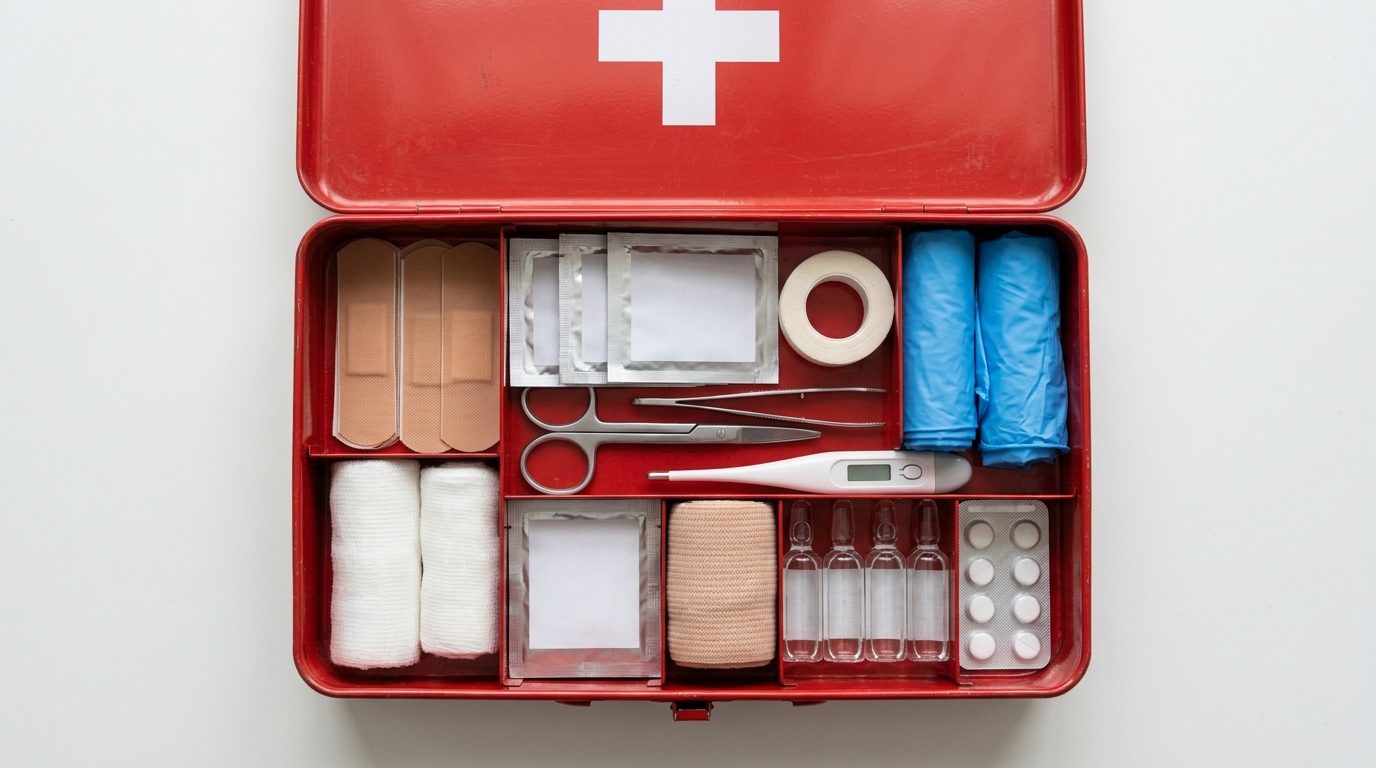
First aid
In an emergency, medical services may take time to arrive. Knowing basic first aid can save lives. This guide does not replace hands-on training. Take a BLS (basic life support) course.
When to call 112?
Call 112 (INEM, the National Institute for Medical Emergency) whenever there is: loss of consciousness, severe difficulty breathing, bleeding that will not stop, chest pain, suspected stroke (face drooping, arm weakness, slurred speech), seizures, major trauma, extensive burns. Call SNS 24 (808 24 24 24) for non-urgent situations: fever, vomiting, medication queries, minor injuries.
Recovery position
When to use: unconscious person who IS BREATHING
The recovery position keeps the airway open and prevents the casualty from choking on vomit or the tongue falling back.
- Check whether the person is breathing (watch the chest, feel for air on your cheek, listen, max. 10 seconds)
- Kneel beside the casualty
- Place the nearest arm at a right angle (palm facing up)
- Bring the far arm across the chest and place the back of the hand against the casualty's cheek (on your side)
- With your other hand, bend the far knee
- Pull the bent knee towards you to roll the casualty onto their side
- Adjust the upper knee for stability (right angle)
- Tilt the head slightly back (to open the airway)
- Check breathing regularly until INEM arrives
CPR: Basic Life Support (BLS)
When to use: unconscious person who is NOT BREATHING
Every minute without CPR reduces the chance of survival by 10%. Even without training, doing compressions is better than doing nothing.
CPR for adults
- Check the scene is safe
- Call out to the casualty: tap the shoulders, ask "Are you alright?"
- Check breathing: look-listen-feel (max. 10 sec)
- Call 112 (or ask someone to) and request an AED if available
- Chest compressions:
- Centre of the chest, between the nipples
- Heel of the palm with hands interlocked
- Arms straight, shoulders directly above the hands
- 30 compressions at 5-6 cm depth
- Rate: 100-120 per minute (the tempo of "Stayin' Alive")
- 2 rescue breaths: tilt head, lift chin, pinch nose, blow for 1 sec (watch the chest rise)
- Repeat cycles of 30:2 until: INEM arrives, the casualty moves/breathes, an AED is available, or you are exhausted
CPR for children (1-8 years)
- 5 initial rescue breaths (children commonly stop breathing due to lack of oxygen)
- Compressions: 1 or 2 hands depending on the child's size, depth approx. 5 cm
- Ratio: 30 compressions : 2 rescue breaths
- If alone: perform 1 minute of CPR BEFORE calling 112
CPR for infants (<1 year)
- 5 rescue breaths covering the baby's mouth AND nose
- Compressions: two-thumb technique (hands encircling the chest) is preferred, or the heel-of-one-hand technique as an alternative. Depth approx. 4 cm
- Ratio: 30:2
- If alone: 1 minute of CPR before calling 112
If you cannot or prefer not to give rescue breaths
Give continuous chest compressions only (hands-only CPR). Uninterrupted compressions are far more effective than doing nothing. The 112 operator will guide you by phone.
Airway obstruction (Heimlich manoeuvre)
Adults and children over 1 year
Signs: person clutches their throat, cannot speak/cough/breathe, lips turning blue.
- If coughing: encourage them to cough forcefully (do not interfere)
- If not coughing: 5 back blows (between the shoulder blades, with the heel of the palm)
- If unsuccessful: 5 abdominal thrusts (Heimlich manoeuvre):
- Stand behind the casualty, make a fist above the navel
- Other hand over the fist
- Quick inward and upward thrusts
- Alternate 5 back blows / 5 abdominal thrusts until the obstruction clears or the person loses consciousness
- If they lose consciousness: begin CPR (compressions may dislodge the object)
Infants under 1 year
- Place the baby face-down on your forearm, head lower than the body
- 5 back blows between the shoulder blades with the heel of the palm
- Turn the baby face-up
- 5 chest thrusts with 2 fingers on the centre of the chest
- Alternate until the obstruction clears or the baby loses consciousness
- NEVER attempt to remove the object blindly with your fingers (you may push it further in)
Pregnant women and obese casualties
Use chest thrusts instead of abdominal thrusts.
Haemorrhage control
External bleeding
- Direct pressure: press firmly with a clean cloth or gauze pad
- Maintain continuous pressure (minimum 10-15 minutes)
- Do NOT remove blood-soaked cloths. Add more on top
- Elevate the limb above heart level if possible
- If blood is pulsing (arterial): apply very firm pressure and call 112 immediately
Tourniquet: last resort
- Use only when direct pressure fails AND the bleeding is life-threatening
- Apply 5-7 cm above the wound (never over a joint)
- Tighten until the bleeding stops
- Note the TIME of application (write it on the forehead or on the tourniquet)
- Do NOT loosen it. Wait for the professionals
- Call 112 immediately
Burns
First aid for burns
- Cold running water over the burn for at least 20 minutes
- Remove clothing or jewellery from the area (UNLESS stuck to the skin)
- Cover with cling film or a clean dressing
Do NOT:
- Do NOT apply ice (causes further damage)
- Do NOT apply toothpaste, butter, egg white or other "home remedies"
- Do NOT burst blisters
- Do NOT stick adhesive dressings directly on the burn
Call 112 if: the burn is larger than the casualty's palm, on the face/hands/genitals/joints, a circumferential burn on a limb, an electrical or chemical burn, or in children/elderly people.
Fractures and sprains
What to do
- Immobilise in the position found (use an improvised splint: magazine, branch, umbrella)
- Do NOT try to realign the bone or reduce the fracture
- Do NOT move the casualty if you suspect a spinal injury (fall >2 m, road accident, diving)
- Apply ice wrapped in a cloth (never directly on the skin), 20 minutes on, remove for at least 20 minutes before reapplying
- Elevate the limb if possible
- Call 112 if: visible deformity, unable to move the limb, severe pain, numbness, open fracture (bone visible)
BLS courses in Portugal
Take a course: this guide does NOT replace hands-on training
Knowing the theory is important, but practising on a mannequin is essential. A BLS course takes 3-6 hours and may be free.
INEM
- Free BLS course (3 h)
- BLS + AED course (6 h)
- Sign up: inem.pt
- High demand, register well in advance
Cruz Vermelha (Red Cross)
- First aid course (12-16 h)
- Cost: EUR 30-60
- cruzvermelha.pt
- Available nationwide
Local fire brigade
- Many stations offer training
- Contact your local fire brigade
- Often free or at a nominal cost
- Good for groups and companies
Quick contacts
Emergency
112: INEM / Emergency
Cardiac arrest, major trauma, haemorrhage, difficulty breathing
Non-urgent
808 24 24 24: SNS 24
Fever, medication queries, minor injuries, clinical guidance
Poisoning
800 250 250: CIAV
CIAV (Poison Information Centre). Poisoning, venomous bites and stings
First aid kit
To assemble a complete home first aid kit, see our medical kit guide. For the car, see the car emergency kit.