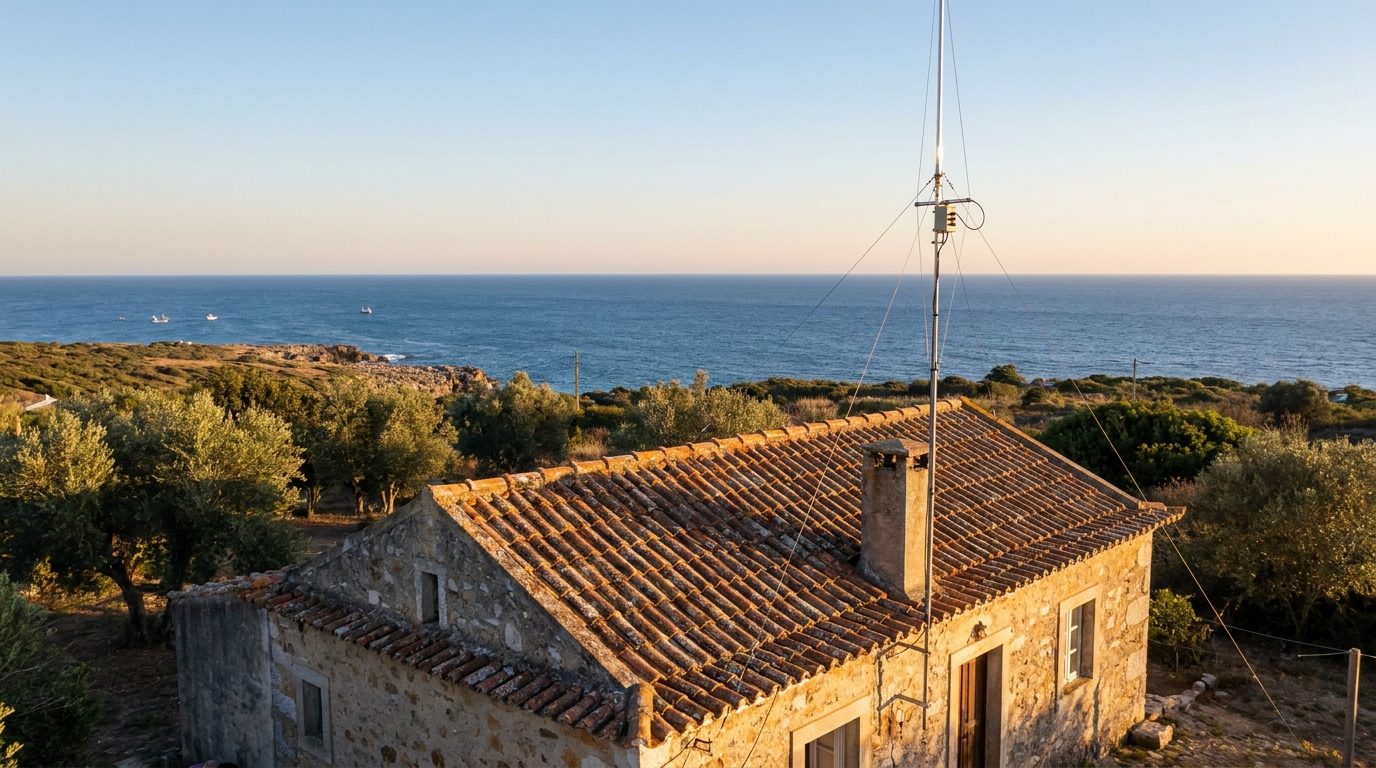
Off-grid communication
When mobile phones and the internet fail, these are the alternatives for staying in touch with family and emergency services. A complete guide with a range calculator and setup tutorials.
Why does this matter?
During natural disasters, mobile networks become overloaded or go down entirely. Communication towers can fall and electricity can fail. Having an alternative means of communication can save lives, allowing you to contact family, call for help, or receive instructions from authorities.
Radio range calculator
Estimate your radio's range based on equipment type, terrain, and elevation. Values are approximate and may vary with atmospheric conditions and obstacles.
Tips to improve range
- Moving to a high point (hilltop, top floor) can double your range
- Keep the antenna vertical for maximum propagation
- Avoid transmitting near metal buildings or high-voltage power lines
Line-of-sight formula
The base formula for line-of-sight range is: D (km) ≈ 4.12 x (√h1 + √h2) where h1 and h2 are heights in metres. This is then adjusted for terrain type, power output, and antenna.
PMR446: the simplest option
What is PMR446?
Licence-free walkie-talkie radios available throughout the European Union. They operate on the 446 MHz frequency with a maximum power of 0.5W. They are the most accessible and easy-to-use option for family emergency communication.
- 16 channels: 1-8 analogue, 9-16 digital
- Channel 1: Conventionally used for emergencies
- Real-world range: 1-3 km city, 3-5 km suburb, 5-10 km open countryside
- Cost: EUR 30-70 per pair
Tutorial: Setting up PMR446 for emergencies
Step 1: Choose a channel
Pick a primary channel (e.g. Channel 5) and a backup channel (e.g. Channel 8) for the family. Avoid channels 1 and 3, which are the most heavily used. Write down the channels and share them with every family member.
Step 2: Set a CTCSS/DCS code
CTCSS codes add a sub-tone that filters out conversations from other users (this is not encryption, just privacy). Set the same code on every radio in the family.
Step 3: Test the range
Before an emergency, test the range between home and work, school, and relatives' homes. Identify dead zones and high points where the signal is better.
Step 4: Agree on a protocol
Set listening times (e.g. 8:00, 13:00, 20:00 for 5 minutes each). Use short, clear sentences. Say "Over" at the end of each message and wait for a response.
Step 5: Spare batteries
Most PMR446 radios use 3-4 AAA batteries. Keep at least 2 spare sets. Lithium batteries last longer in extreme cold.
CTCSS code table
Set the same code on every radio in the family to filter out third-party conversations:
| Code | Frequency | Code | Frequency | Code | Frequency |
|---|---|---|---|---|---|
| 1 | 67.0 Hz | 13 | 103.5 Hz | 25 | 156.7 Hz |
| 2 | 71.9 Hz | 14 | 107.2 Hz | 26 | 162.2 Hz |
| 3 | 74.4 Hz | 15 | 110.9 Hz | 27 | 167.9 Hz |
| 4 | 77.0 Hz | 16 | 114.8 Hz | 28 | 173.8 Hz |
| 5 | 79.7 Hz | 17 | 118.8 Hz | 29 | 179.9 Hz |
| 6 | 82.5 Hz | 18 | 123.0 Hz | 30 | 186.2 Hz |
| 7 | 85.4 Hz | 19 | 127.3 Hz | 31 | 192.8 Hz |
| 8 | 88.5 Hz | 20 | 131.8 Hz | 32 | 203.5 Hz |
| 9 | 91.5 Hz | 21 | 136.5 Hz | 33 | 210.7 Hz |
| 10 | 94.8 Hz | 22 | 141.3 Hz | 34 | 218.1 Hz |
| 11 | 97.4 Hz | 23 | 146.2 Hz | 35 | 225.7 Hz |
| 12 | 100.0 Hz | 24 | 151.4 Hz | 36-38 | 229-254 Hz |
Recommended models
Motorola T82 Extreme
IPX4 water-resistant, built-in torch, range up to 10 km in ideal conditions. Excellent build quality.
Motorola T62
Basic and reliable model. A good option to start without a big investment.
Baofeng BF-888S
Very affordable, but check it is limited to 0.5W (the PMR446 legal limit). Variable quality.
Midland G7 Pro
Popular among hikers and campers. Good value for money.
CB Radio: medium range
Citizen Band (CB)
Operates on 27 MHz with 40 channels and a maximum power of 4W AM or 12W SSB. Licence-free in Portugal since 2003, no ANACOM (Portuguese communications regulator) licence required.
- Channel 9 (27.065 MHz): International emergency channel
- Channel 19: General conversation, widely used by truck drivers
- Range: 5-20 km typical, up to 50 km+ with good atmospheric propagation
What to buy
President Bill ASC
Compact, easy to install in a car. ASC (Automatic Squelch Control) reduces noise.
Midland Alan 48 Plus
Versatile model with good receive sensitivity.
Car magnetic antenna
Essential for mobile CB. Attaches to the car roof with a magnet.
Sirio GP27 base antenna
For a fixed home installation. Significantly improves range.
Amateur radio: long range
Licence required
Transmitting on amateur radio frequencies requires an ANACOM (Portuguese communications regulator) licence. Transmitting without a licence is illegal and may result in fines. Listening is legal without a licence.
How to get a licence
- ANACOM exam: approx. EUR 30, a theory test on regulations and technical knowledge
- Class 2: local VHF/UHF, 2-4 months of study
- Class 1: includes HF (worldwide range), 4-8 months of study
- Callsign: CT + suffix (e.g. CT1ABC)
Range by band
- VHF/UHF: 20-80 km via repeaters (ARVM, REP)
- HF: National and international range, ideal for severe emergencies
- Digital modes: FT8, Winlink (email via radio)
Organisations in Portugal
- REP: Rede dos Emissores Portugueses (Portuguese Amateur Radio Society), rep.pt
- ARES Portugal: Amateur Radio Emergency Service
Entry-level equipment
Baofeng UV-5R
Affordable VHF/UHF radio. Excellent for listening (legal without a licence) and later for use with a licence. Requires programming.
Repeater map for Portugal
Repeaters extend the range of VHF/UHF radios. Check the online maps to find repeaters in your area:
repetidores.pt
Interactive map with VHF, UHF, DMR, and D-STAR repeaters in Portugal.
rep.pt
Official REP list with 212+ repeaters in their network.
RepeaterBook
International database with 192+ Portuguese repeaters.
Key repeaters by region
| Region | Callsign | TX Frequency | Shift | Location |
|---|---|---|---|---|
| Lisbon | CQ0UAL | 145.600 MHz | -600 kHz | Serra de Sintra |
| Porto | CQ0UP | 145.625 MHz | -600 kHz | Serra do Pilar |
| Coimbra | CQ0UC | 145.650 MHz | -600 kHz | Serra da Lousa |
| Faro | CQ0UFA | 145.675 MHz | -600 kHz | Foia (Monchique) |
| Evora | CQ0UE | 145.700 MHz | -600 kHz | Serra d'Ossa |
| Viseu | CQ0UV | 145.725 MHz | -600 kHz | Serra do Caramulo |
| Braga | CQ0UB | 145.750 MHz | -600 kHz | Serra do Geres |
| Madeira | CQ0UM | 145.775 MHz | -600 kHz | Pico do Areeiro |
Note: Frequencies and callsigns may change. Always check official sources for up-to-date information.
Offline digital communication
Meshtastic / LoRa
LoRa devices running Meshtastic firmware create mesh networks that work without internet or communication towers. Messages hop from device to device, extending the range.
- Cost: EUR 25-40 per device
- Range: 5-15 km between nodes, potentially unlimited via mesh
- Licence: Not required (ISM band)
- Advantage: Battery lasts for days, communicates via a phone app
meshtastic.org for documentation and setup guides
Briar
An Android messaging app that works via Bluetooth or Wi-Fi Direct, with no internet needed. Ideal for local communication when the network goes down.
- Cost: Free
- Range: approx. 10-100 m (Bluetooth/Wi-Fi Direct)
- Advantage: Encrypted, works on any Android device
goTenna
Mesh devices that pair with your phone via Bluetooth. They send text messages and GPS locations without a network.
- Cost: EUR 100-200 per pair
- Range: approx. 5 km urban, more in open countryside
- Advantage: Easy to use, intuitive app
Satellite internet
Starlink
SpaceX's satellite internet system. It works independently of ground infrastructure. If communication towers fall or cables are damaged, Starlink remains operational as long as it has power.
Advantage in emergencies
Starlink does not depend on poles, cables, or telecommunication towers. All it needs is a clear view of the sky and a power source (it can run on a generator, power station, or solar panels).
Options available in Portugal
Starlink Mini
Compact and portable (1.1 kg). Ideal for mobile emergencies, fits in a backpack. Speeds up to 100 Mbps. No upfront hardware cost with an active plan.
Starlink Standard
Fixed home kit. Speeds 50-200 Mbps, latency approx. 25-50 ms. *Free hardware with a 12-month contract, or approx. EUR 149-349 without a contract.
Starlink Roam
Mobile plan, use it anywhere. Ideal for motorhome travel, frequent trips, or a secondary home.
Emergency power supply
Power station 500-1000 Wh + 100-200W solar panel. Starlink Standard uses approx. 75-100W, the Mini approx. 25-60W.
Updated pricing
Starlink prices change frequently with promotions. Always check starlink.com/pt for current prices. In Portugal, the Residential Lite plan starts at EUR 29/month.
Emergency usage tips
- Clear sky view: Requires an unobstructed view of the sky (minimum 100 degree opening)
- Power: Always have a charged power station or a generator ready
- Starlink app: Lets you check for obstructions and signal quality before installing
- Power-saving mode: On the Mini, enable power-saving mode when not in use
- Communication backup: Combine PMR446 for local communication with Starlink for internet
Other satellite options
- Satellite phone (Iridium, Thuraya): EUR 800-1500 + EUR 50-150/month. Voice and SMS anywhere in the world. Useful for very remote areas.
- Garmin inReach: EUR 350-450 + EUR 15-50/month. A GPS device with satellite messaging and an SOS button. Ideal for hiking and outdoor activities.
- Globalstar SPOT: EUR 150-250 + EUR 12-25/month. A GPS tracker with an SOS button and pre-set messages.
Physical and analogue signals
When technology fails completely, traditional methods may be the only option:
- Whistle: 3 short blasts = call for help (international mountaineering convention)
- Signal mirror: Reflects sunlight to attract the attention of helicopters or rescue teams
- Brightly coloured cloth: Orange or red, visible from a distance. Spread it on the ground or wave it
- Torch SOS: 3 short, 3 long, 3 short (Morse code for SOS)
- Note on the door: If you evacuate, leave the date/time, destination, and number of people
- Community notice board: Agree with neighbours on a place to leave physical messages
Family communication plan
Decide before an emergency how the family will communicate if mobile phones do not work:
Essential plan elements
- Primary and backup PMR446 channel: e.g. Channel 5 (primary), Channel 8 (backup)
- CTCSS code: The same for the whole family
- Listening times: 8:00, 13:00, 20:00 for 5 minutes
- Radio meeting point: An elevated location where the signal is stronger
- Status codes:
- "All green": We are fine, safe
- "Yellow": Difficult but controlled situation
- "Red": Emergency, we need help
- "Return to base": Meet at the rally point
NATO phonetic alphabet
Use it to spell out names or important information clearly:
A-Alfa, B-Bravo, C-Charlie, D-Delta, E-Echo, F-Foxtrot, G-Golf, H-Hotel, I-India, J-Juliet, K-Kilo, L-Lima, M-Mike, N-November, O-Oscar, P-Papa, Q-Quebec, R-Romeo, S-Sierra, T-Tango, U-Uniform, V-Victor, W-Whiskey, X-X-ray, Y-Yankee, Z-Zulu
Solution comparison
| Solution | Cost | Range | Licence | Difficulty | Best for |
|---|---|---|---|---|---|
| PMR446 (pair) | EUR 30-70 | 1-10 km | No | Easy | Family, short distance |
| CB radio + antenna | EUR 70-130 | 5-30 km | No | Medium | Car, medium distance |
| Amateur VHF | EUR 100-300 | 20-80 km | Yes | Hard | Regional emergencies |
| Amateur HF | EUR 400-1000+ | National+ | Yes | Hard | Severe disasters |
| Meshtastic LoRa | EUR 25-40/unit | 5-15 km | No | Medium | Groups, text/GPS |
| Starlink Mini | EUR 0* + EUR 29/month | Global | No | Easy | Full internet, portable |
| Starlink Standard | EUR 0-349* + EUR 29-40/month | Global | No | Easy | Home internet, backup |
| Garmin inReach | EUR 350-450 + EUR 15/month | Global | No | Easy | SOS, outdoor, GPS |
| Briar (app) | Free | 10-100 m | No | Easy | Close range, encrypted |
| Whistle + signals | EUR 2-5 | 200 m - 2 km | No | Easy | Rescue, last resort |
Recommendation by level
Basic: A pair of PMR446 radios (EUR 50-70) + an FM radio for official broadcasts from Antena 1 (Portuguese public radio).
Intermediate: Add Meshtastic for larger groups or CB for greater range without a licence.
Advanced: Starlink Mini with a power station guarantees internet access independent of ground infrastructure. Ideal for remote work, extended emergencies, or rural areas.