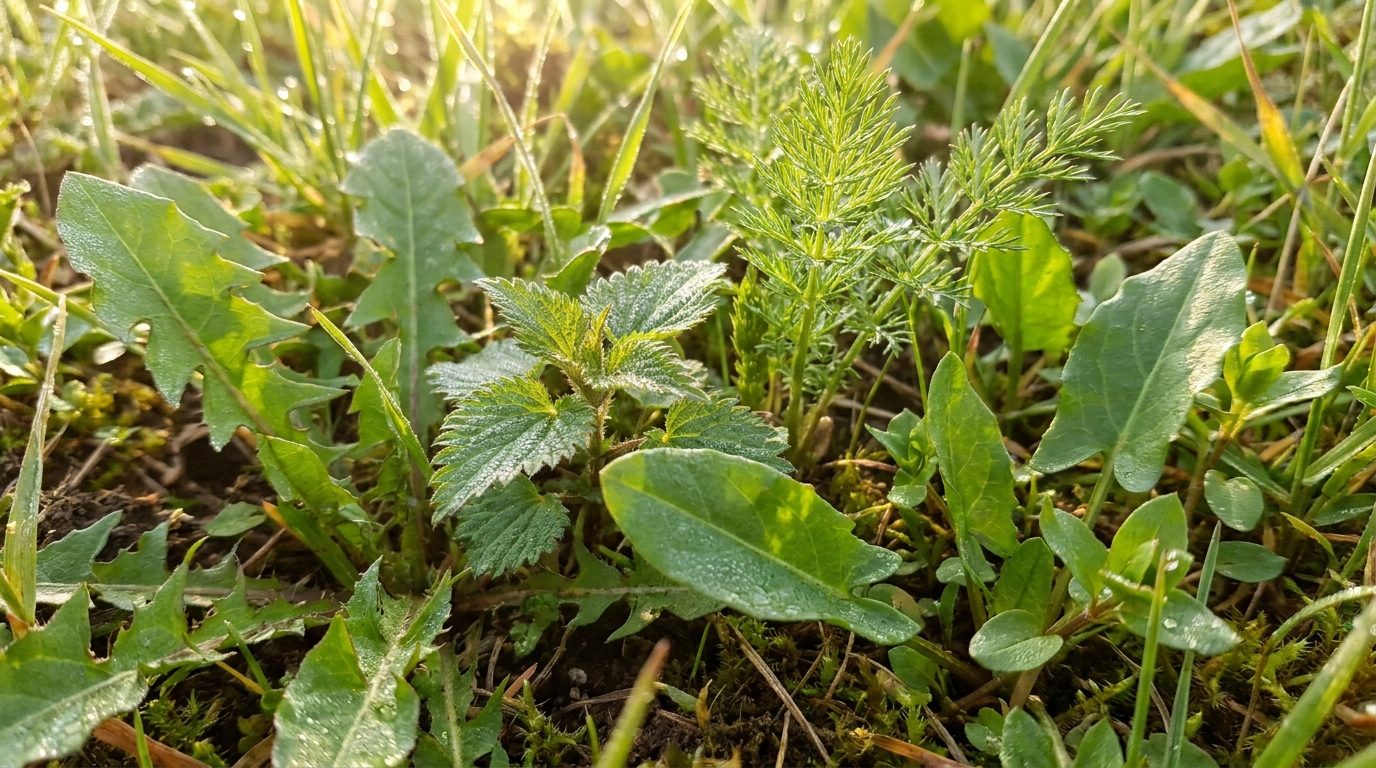
Wild edible plants
Portugal's mild climate and diverse landscapes support a wide range of edible wild plants. In an extended emergency, foraging knowledge could supplement your food supplies. But safety comes first.
The golden rule: if in doubt, do not eat it
Misidentifying a plant can be fatal. Some of Portugal's most dangerous plants closely resemble edible species. Never eat a plant you cannot identify with 100% certainty. This guide is an introduction, not a field manual. Learn from experienced foragers before relying on wild plants for food.
Safety rules
Before foraging
- 100% identification: never eat a plant unless you are absolutely certain of its identity
- Learn before an emergency: practise identification now, not when you are hungry and stressed
- Use multiple identification features: leaf shape alone is not enough. Check stem, flowers, smell, habitat, and season
- Start with easy species: begin with plants that have no dangerous lookalikes (e.g. carob, fennel)
- Small portions first: even correctly identified plants can cause allergic reactions. Try a small amount and wait 24 hours
Where to forage
- Avoid roadsides: plants absorb exhaust fumes and heavy metals
- Avoid treated areas: fields, parks, and gardens may be sprayed with pesticides or herbicides
- Avoid contaminated water: do not harvest plants near polluted streams or drains
- Wash everything: rinse in clean water before eating, even in the wild
- Respect the law: foraging in nature reserves or protected areas may be restricted
- Sustainable harvesting: never take more than a third of any plant stand. Leave enough for regeneration and wildlife
12 edible plants found in Portugal
Purslane (Portulaca oleracea)
PT: Beldroega
- Where: gardens, fields, roadsides, cracks in pavements. Extremely common in summer
- Identification: succulent, reddish stems, small fleshy oval leaves, tiny yellow flowers
- Nutrition: rich in omega-3 fatty acids, vitamin C, and iron. One of the most nutritious wild plants
- How to eat: raw in salads, sauteed with garlic, added to soups. Traditional in Portuguese cuisine
Dandelion (Taraxacum officinale)
PT: Dente-de-leao
- Where: lawns, fields, roadsides, meadows. Available year-round
- Identification: jagged (toothed) leaves in a rosette, yellow flower heads, milky sap in stems
- Nutrition: vitamins A, C, K, iron, and calcium
- How to eat: young leaves raw in salads (older leaves are bitter, boil to reduce bitterness), roots can be roasted as a coffee substitute, flowers can be made into tea
Sow thistle (Sonchus oleraceus)
PT: Serralha
- Where: gardens, disturbed ground, walls, fields. Very common throughout Portugal
- Identification: milky sap, soft spiny-edged leaves, small yellow dandelion-like flowers
- Nutrition: vitamin C, calcium, iron
- How to eat: young leaves raw or cooked. Traditional vegetable in Portuguese rural cooking. Older leaves should be boiled
Stinging nettle (Urtica dioica)
PT: Urtiga
- Where: moist, shaded areas, riverbanks, woodland edges
- Identification: heart-shaped, serrated leaves covered in stinging hairs. Grows up to 1.5 m
- Nutrition: exceptionally rich in iron, calcium, vitamin A, and protein
- How to eat: always cook (boiling destroys the stinging hairs). Use gloves to harvest. Excellent in soups, as a spinach substitute, or dried for tea
Sorrel (Rumex acetosa)
PT: Azeda
- Where: meadows, pastures, woodland clearings
- Identification: arrow-shaped leaves, reddish stems, sour taste (oxalic acid)
- Nutrition: vitamin C, potassium
- How to eat: young leaves raw in salads or cooked in soups. Eat in moderation due to oxalic acid content (avoid if you have kidney stones)
Acorn (Quercus spp.)
PT: Bolota
- Where: cork oak and holm oak forests (montados), widespread in southern and central Portugal
- Identification: oval nuts in a cup-shaped cap, from oak trees
- Nutrition: high in carbohydrates and fat. Calorie-dense survival food
- How to eat: must be leached first to remove tannins (soak in water for several days, changing water daily, or boil repeatedly). Ground into flour for bread or porridge
Carob (Ceratonia siliqua)
PT: Alfarroba
- Where: Algarve and southern Portugal. Drought-resistant, common in dry rocky areas
- Identification: evergreen tree, leathery compound leaves, long dark brown pods (ripe in autumn)
- Nutrition: high in natural sugars, fibre, calcium, and iron
- How to eat: pods can be eaten raw when ripe (sweet, chocolate-like flavour). Seeds are very hard and not edible without processing. Pods can be dried and ground into flour
Fennel (Foeniculum vulgare)
PT: Funcho
- Where: roadsides, disturbed ground, coastal areas. Extremely common throughout Portugal
- Identification: tall (up to 2 m), feathery leaves, yellow flower umbels, strong aniseed scent. No dangerous lookalikes when smell is confirmed
- Nutrition: vitamin C, potassium, fibre
- How to eat: leaves raw or cooked, bulb sliced in salads or roasted, seeds for tea. Used in traditional Portuguese fish dishes
Mallow (Malva sylvestris)
PT: Malva
- Where: roadsides, fields, gardens, waste ground. Very common
- Identification: round leaves with 5 to 7 lobes, purple flowers with darker veins
- Nutrition: mucilaginous (soothing for the throat), vitamin A and C
- How to eat: young leaves raw in salads, older leaves cooked in soups (mucilaginous texture thickens broth). Flowers are edible. Traditionally used as a medicinal tea in Portugal
Wild asparagus (Asparagus acutifolius)
PT: Espargos bravos
- Where: Mediterranean scrubland, hedgerows, woodland edges. Spring harvest
- Identification: thin, dark green spears emerging from thorny parent plant. Much thinner than cultivated asparagus
- Nutrition: folate, vitamin K, antioxidants
- How to eat: snap off tender tips, cook as you would regular asparagus. Popular in Portuguese omelettes (migas de espargos)
Chicory (Cichorium intybus)
PT: Chicoria
- Where: roadsides, fields, dry grasslands. Distinctive blue flowers in summer
- Identification: rosette of dandelion-like basal leaves, bright blue flowers on tall rigid stems
- Nutrition: inulin (prebiotic fibre), vitamins A and K
- How to eat: young leaves in salads (bitter, similar to endive). Roots can be roasted and ground as a coffee substitute (caffeine-free)
Watercress (Nasturtium officinale)
PT: Agriao
- Where: streams, springs, wet ditches. Grows in clean running water
- Identification: small, round, dark green leaves on hollow stems. Peppery taste
- Nutrition: exceptionally rich in vitamins A, C, K, calcium, and iron
- How to eat: raw in salads and sandwiches, or cooked in soups. Only harvest from clean water sources (risk of liver fluke in stagnant water near livestock)
Toxic plants to avoid
These plants are deadly. Learn to recognise them.
- Hemlock (Conium maculatum / PT: Cicuta): resembles wild carrot or parsley. Purple-spotted hollow stems, mousy smell. All parts are lethal. Found along rivers, ditches, and roadsides
- Deadly nightshade (Atropa belladonna / PT: Beladona): shiny black berries, bell-shaped purple flowers. All parts are toxic. Found in shaded woodland, especially in northern Portugal
- Foxglove (Digitalis purpurea / PT: Dedaleira): tall spikes of tubular purple flowers. All parts contain cardiac glycosides that can cause fatal heart arrhythmia. Common in northern and central Portugal
- Oleander (Nerium oleander / PT: Loendro): popular ornamental shrub with pink, white, or red flowers. All parts are extremely toxic, including smoke from burning branches. Widespread in Portugal
Universal edibility test (last resort only)
If you are in a survival situation with no other food source and need to test an unknown plant:
- Separate the plant into parts (leaves, stems, roots, flowers)
- Test one part at a time. Rub on the inside of your wrist. Wait 15 minutes for a reaction
- Touch to your lip. Wait 15 minutes
- Place on your tongue. Wait 15 minutes
- Chew a tiny piece and spit it out. Wait 15 minutes
- Swallow a tiny piece. Wait 8 hours
- If no reaction at any stage, eat a small portion and wait another 8 hours
This test takes 24+ hours per plant part and is not foolproof. It should only be used as an absolute last resort. Prevention is always better: learn common edible plants before an emergency occurs.
Related guides
For food storage and safety, see our food safety guide. For water treatment, see the water guide. For emergency cooking without gas or electricity, see living without electricity.