Microgreens — step-by-step guide
Young plants with up to 40 times more nutrients than mature vegetables. They grow in a tray in 10 to 25 days. They fit on the kitchen counter.
Microgreens vs sprouts — what is the difference?
Sprouts are eaten whole (root, seed, shoot) without soil. Microgreens grow in substrate and are cut above the root, when they reach 5-7 cm and develop the first true leaves. They are larger, tastier and more nutritious. The two are complementary: sprouts in 5 days for volume, microgreens in 14 days for quality.
Materials needed
Equipment (€15-30)
- Two 25×20 cm trays — one with holes (for the substrate), another without holes (water collector underneath). Supermarket salad boxes work fine.
- Water spray bottle (€2-3)
- Clean kitchen scissors
- Dark tray or cloth to cover during the first days (germination in the dark)
- LED grow light (optional, €20-40) — only if your window receives less than 4 hours of sunlight
Substrate
Recommended mix: 50% peat + 50% coir. Available at any garden centre or Leroy Merlin (€5-10/large bag, lasts months).
Cheap alternatives:
- Coir only — lighter, drains well
- Damp absorbent paper — works, but short-lived
- Jute or linen mat — reusable, biodegradable
Avoid: garden soil (compacts, brings pests), soil with chemical fertilisers.
Recommended seeds
Different plants have different times and flavours. Start with the easiest (radish, rocket, broccoli) — almost impossible to fail.
| Microgreen | Ready in | Flavour | Notes |
|---|---|---|---|
| Radish | 10-12 days | Spicy | Ideal for beginners |
| Rocket | 10-14 days | Spicy, earthy | In salads, sandwiches |
| Broccoli | 10-14 days | Mild, sweet | Sulforaphane (anti-cancer) |
| Mustard | 8-12 days | Strong, spicy | Like wasabi |
| Red cabbage | 10-14 days | Mild, sweetish | Lovely colour |
| Beet | 16-20 days | Sweet, earthy | Red leaves, grows more slowly |
| Sunflower | 10-14 days | Crunchy, oily | Large leaves, filling |
| Pea | 10-14 days | Sweet, green | Long leaves, in smoothies |
| Purple basil | 14-21 days | Aromatic | Slower, requires patience |
| Coriander | 14-21 days | Citrussy | Slow, requires fresh seeds |
| Parsley | 21-25 days | Fresh | Very slow |
Where to buy seeds in Portugal
- Microgreen seeds in large bags (cheaper): Casa das Sementes, Cantinho das Aromáticas, or Amazon (organic seeds).
- Supermarket seeds (lentil, mung, alfalfa) work, but for microgreens it is worth buying specific seeds — higher density, more uniform germination.
- Quantities: one 25×20 cm tray needs 1-2 tablespoons of seeds (depending on size). 250 g of seeds (€3-5) lasts months.
Step-by-step
- Prepare the substrate. Mix peat + coir in a bowl. Add water gradually until it is damp like a wrung-out sponge (not waterlogged).
- Fill the tray with holes. Spread 2-3 cm of substrate. Press lightly to level. Place this tray on top of the collector tray without holes.
- Soak seeds (optional). Larger seeds (sunflower, pea) benefit from a 6-12 hour soak. Small seeds (rocket, mustard) do not need it.
- Sow. Spread seeds densely over the substrate — they should cover the surface in a single layer, without overlapping. More density = more yield (but watch out for mould).
- Press and spray. Press the seeds with the palm of your hand for contact with the substrate. Spray with water (do not over-wet).
- Cover for the first 3-5 days. Cover with another tray turned upside down or a dark cloth. Germination happens in the dark. Spray 1-2 times a day to maintain moisture.
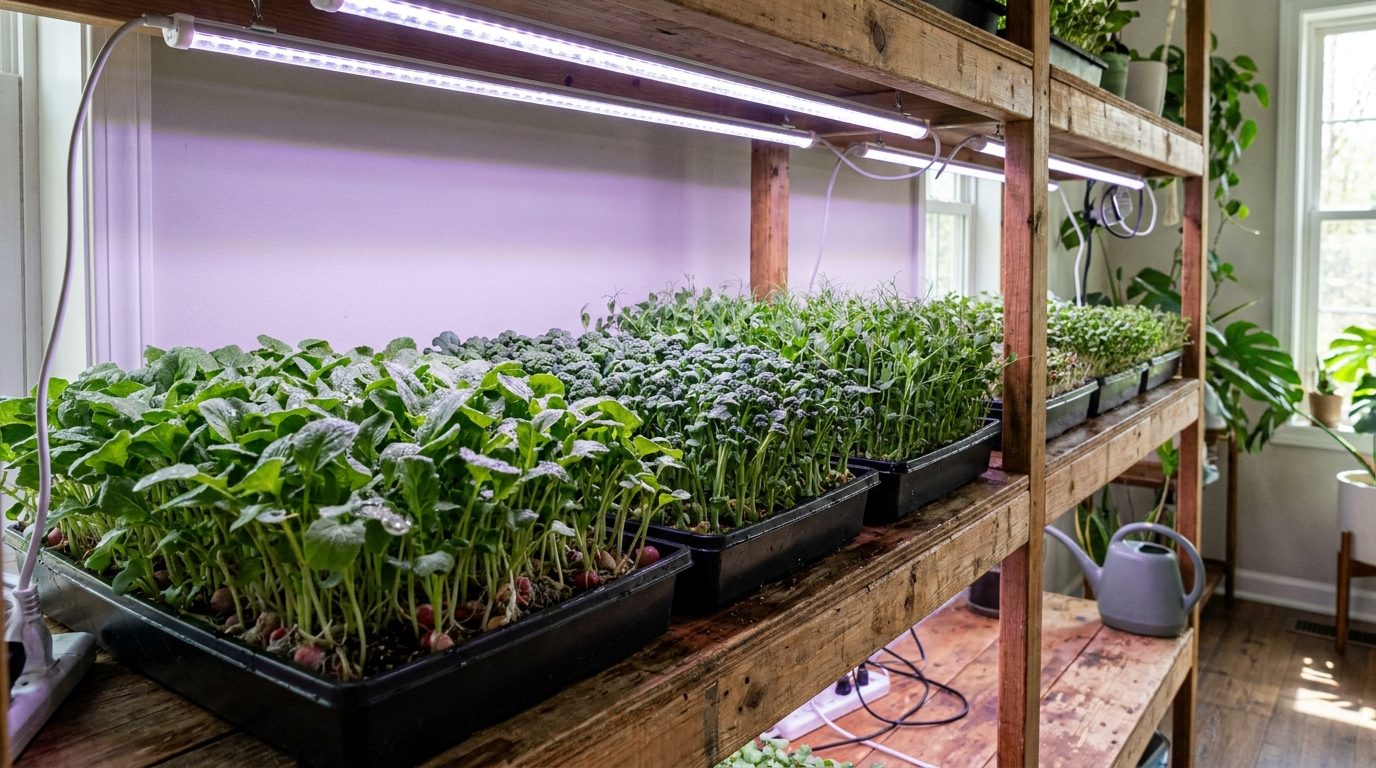
- Expose to light. When the shoots are 2-3 cm tall and pushing the lid up, remove it. Place near a window with indirect light (no strong direct sun) or under an LED grow light (12-16 h/day).
- Water from below. From here on, fill the collector tray (2-3 mm of water) and let the substrate absorb through the holes. Never spray from above — wet leaves + lack of air = mould.
- Harvest. When they reach 5-7 cm and have the first true leaves (10-25 days depending on variety), cut with scissors close to the substrate. Wash and eat fresh. They keep 5-7 days in the fridge.
- Recycle the substrate. After harvesting, discard roots and substrate in the composter (or bokashi). Clean the trays with hot water. Start again.
Mould prevention
Mould is the biggest enemy of microgreens
White fluffy patches, especially grey or black ones, are mould. Different from fine white roots (healthy and located near the seed).
Most common causes:
- Too much water — waterlogged substrate
- Lack of ventilation — no air circulation
- Seeds too dense — leaves touch each other with no air between them
- Covered for too long during the dark phase
- Trays badly cleaned between batches
Prevention:
- Water from below, never from above after exposure to light
- Keep the environment well ventilated (window ajar, small fan)
- Do not cover for more than 5 days
- Wash trays with boiling water between batches
- Space out batches — do not stack trays on top of each other
- If mould appears: discard the whole batch (do not try to save parts) and restart with thoroughly washed trays
LED lighting — when do you need it?
Microgreens need light from day 4-5 (after germination). If your window receives at least 4 hours of clear indirect light, you do not need LED. If your window faces north, you have no nearby window, or you want to grow all year round: LED is a good option.
- Type: full spectrum LED (white light with red and blue)
- Power: 20-40 W per tray
- Duration: 12-16 h/day (use a timer)
- Distance: 20-30 cm above the plants
- Cost: €20-50 (Amazon, Leroy Merlin)
- Electricity consumption: 0.5 kWh/day ≈ €7/month for 30 W over 14 h
Continuous rotation — weekly production
For a weekly harvest, sow a new tray every 7 days. In a few weeks you will have 2-3 trays at different stages — harvest one and start another.
Production plan: one tray a week
- Week 1, Monday: sow tray 1 (radish)
- Week 2, Monday: sow tray 2 (rocket). Tray 1 almost ready.
- Week 2, Friday: harvest tray 1
- Week 3, Monday: sow tray 3 (broccoli). Tray 2 almost ready.
- Continues like this indefinitely
Result: ~150 g of fresh microgreens per week, €8/month in seeds, no dependence on the supermarket.
How to use them in the kitchen
In salads
Replace lettuce. Mix several varieties for a complex flavour.
In sandwiches
One handful per sandwich. Crunchy, more nutritious than lettuce.
In scrambled eggs
Add in the last 30 seconds. Do not cook longer.
As a garnish
On soups, fish, meat. A touch of colour and fresh flavour.
In green smoothies
Broccoli, pea: one handful in a smoothie with fruit.
In pesto
Microgreen basil + olive oil + Parmesan + garlic. Fresh pesto.