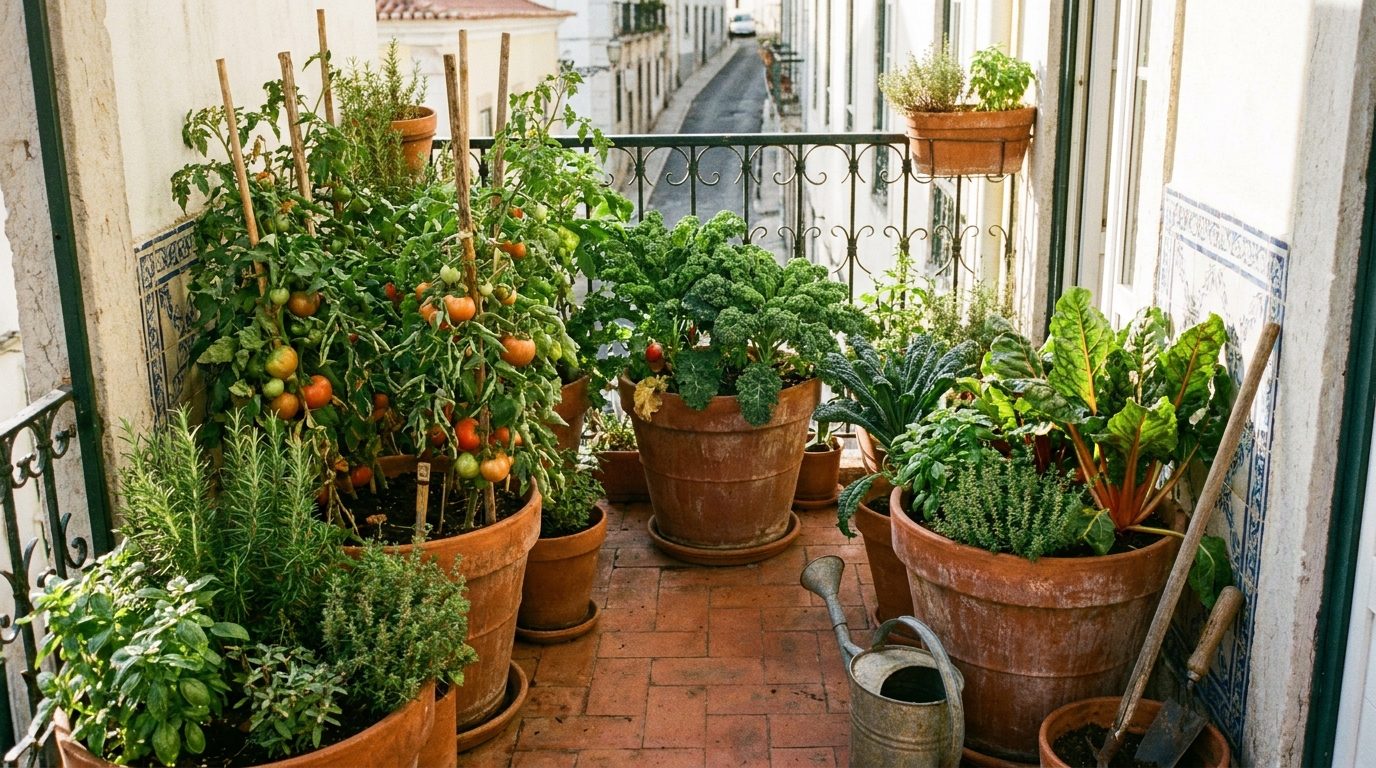
Container plants on the balcony
Fresh vegetables and herbs in containers. Adapted to the Portuguese climate, the typical balcony size and the Mediterranean diet.
What is achievable on a 2 m² balcony?
On a small balcony (2 m²) with at least 4 hours of sun per day you can produce: 1-2 cherry tomato plants (4-6 kg/year), 3-4 pots of culinary herbs (parsley, basil, mint on a continuous basis), 1-2 bell pepper plants (10-20 fruits/year), and lettuce or spinach in continuous rotation. Realistic total: 8-12 kg of fresh vegetables per year.
Table: what to plant in containers
| Plant | Pot (L) | Sun | Yield | Time to harvest |
|---|---|---|---|---|
| Cherry tomato | 15-20 | Full sun | 2-3 kg/plant | 3-4 months |
| Standard tomato | 25-30 | Full sun | 4-6 kg/plant | 4-5 months |
| Bell pepper | 10-15 | Full sun | 5-10 fruits | 4 months |
| Courgette | 30+ | Full sun | 5-15 fruits | 2-3 months |
| Lettuce | 5 | Partial shade | Continuous leaves | 4-6 weeks |
| Rocket | 3-5 | Partial shade | Continuous leaves | 30 days |
| Spinach | 5 | Partial shade | Continuous leaves | 4-6 weeks |
| Portuguese cabbage (tronchuda) | 15 | Sun/partial | Continuous leaves | 4-6 months |
| Strawberry | 3-5 | Sun | 0.5-1 kg/plant | continuous (perennial) |
| Basil | 3-5 | Sun | continuous | continuous (annual) |
| Parsley | 3 | Partial shade | continuous | continuous (biennial) |
| Coriander | 3 | Sun/partial | single harvest | 6 weeks |
| Mint | 5 (isolated pot) | Partial shade | continuous | continuous (perennial) |
| Thyme | 3 | Sun | continuous | continuous (perennial) |
| Rosemary | 10 | Sun | continuous | continuous (perennial) |
| Chives | 3 | Sun/partial | continuous | continuous (perennial) |
| Oregano | 3 | Sun | continuous | continuous (perennial) |
Mint kept on its own: mint is invasive — the roots spread and smother other plants. Always in a pot of its own.
Planting calendar in Portugal
Mainland Portugal has a Mediterranean climate. In high-altitude areas (Trás-os-Montes, Beira Interior) shift the calendar 2-3 weeks later in spring and earlier in autumn.
Winter (Dec-Feb)
Plant:
- Portuguese cabbage, cauliflower, red cabbage
- Garlic (individual cloves)
- Onions (sets or seedlings)
- Broad beans and peas
- Spinach (it likes the cool)
- Winter lettuce (hardy varieties)
Spring (Mar-May)
Plant:
- Tomato (sow in March, transplant in April)
- Bell pepper, chilli pepper
- Courgette, pumpkin/squash
- Green beans
- Lettuce, rocket
- Basil, coriander
- Strawberries (everbearing variety)
Summer (Jun-Aug)
Plant:
- Lettuce (in a shaded spot)
- Rocket, spinach (in shade)
- Microgreens (any month)
- Basil, parsley, chives
Maintain: water more (1-2× per day on hot days), shield from the midday sun (12-16 h) where possible.
Autumn (Sep-Nov)
Plant:
- Cabbages (all varieties)
- Autumn lettuce
- Spinach
- Radish
- Garlic (September-October for the following summer's harvest)
- Winter onions
How to start — step by step
- Assess the space. Measure how much direct sunlight the balcony receives (record one morning, one afternoon): <3 h = herbs/leaves only; 3-6 h = leaves + a few fruits; >6 h = tomato, bell pepper, courgette feasible.
- Buy pots with drainage. Plastic pots with holes in the base + saucers. Plastic heats up less in the sun than terracotta and is lighter. Size as per the table above.
- Suitable substrate. Buy universal potting compost from a garden centre (NOT garden soil, which compacts). Mix in 20% perlite or sand for better drainage. 50 L bag: €5-8.
- Plant. Fill the pot to within 2 cm of the rim. Make a hole, place the plant (sized to the root ball), firm in gently. Water until water runs out of the holes.
- Water consistently. Check daily. The compost should always be slightly moist (not waterlogged). In summer 1-2× per day may be needed. In winter once every 3 days may be enough.
- Feed. Compost runs out in 2-3 months. Add organic fertiliser (compost, worm castings, bokashi liquid 1:100) every 2 weeks during the growing season.
- Staking. Tomato, bean and pea need canes/netting. Bell peppers and courgettes generally hold themselves up.
- Pollination (in a flat). Without bees, help tomato, bell pepper and courgette by gently shaking the flowers or running a soft brush between flowers. No pollination = no fruit.
Companion planting — combinations that work
Planting complementary varieties in the same pot (large pot, 30 L+) or in neighbouring pots can reduce pests and maximise space.
Good combinations
- Tomato + basil: basil repels whitefly, improves the flavour of the tomato
- Carrot + onion: mutual scents confuse carrot flies and onion flies
- Lettuce + radish: radish grows quickly, lettuce grows slowly — they share the space
- Bell pepper + basil: basil protects against aphids
Combinations to avoid
- Onion + pea/bean: onion inhibits legumes
- Tomato + cabbage: they compete for nutrients
- Mint + anything else: mint is invasive, always in an isolated pot
- Fennel + anything else: fennel releases substances that inhibit other plants
Common pests in a flat
Aphids
Small green/black insects on new leaves. They suck the sap.
Solution: spray with a soap solution (1 spoon of mild soap + 1 L water). Repeat after 3 days.
Whitefly
Tiny white flies that take off when the plant is disturbed.
Solution: yellow sticky traps + spray with neem oil.
Red spider mite
Yellow spots on the leaves, fine webbing. Caused by very dry air.
Solution: mist the leaves with water several times a day, neem oil if it persists.
Slugs and snails
Rare on high-rise flats, common on the ground floor.
Solution: a barrier of ash or crushed eggshells around the pots.
Watering system for time away
A weekend away or a holiday compromises potted plants (especially in summer). Solutions:
- Inverted bottle with a hole: a 1.5 L PET bottle full of water, lid pierced, buried in the pot. Releases slowly. Lasts 3-7 days.
- Cotton wick: one end in a bucket of water level with the pot, the other buried in the pot. Capillary action waters slowly.
- Drip irrigation system with timer: full kit €30-50 at Leroy Merlin. Ideal for a balcony with 5+ pots.
- Self-watering pot: built-in reservoir. More expensive but feeds the plant for 1-2 weeks.
Common mistakes
- Pot too small: a tomato in a 5 L pot dies. Limited root space limits yield.
- No drainage: roots rot. Always have holes in the base.
- Garden soil: it compacts in a pot. Use proper potting compost + perlite.
- Overwatering: the leading cause of death. Compost should drain well between waterings.
- Underwatering: in strong sun, pots dry out within hours. In summer it can be 2× per day.
- Not feeding: nutrients run out in 2-3 months. No food = no yield.
- No manual pollination: tomato in a flat without pollination = no fruit.
- Planting everything at once: it all ripens together, then there is a gap. Rotate weekly.