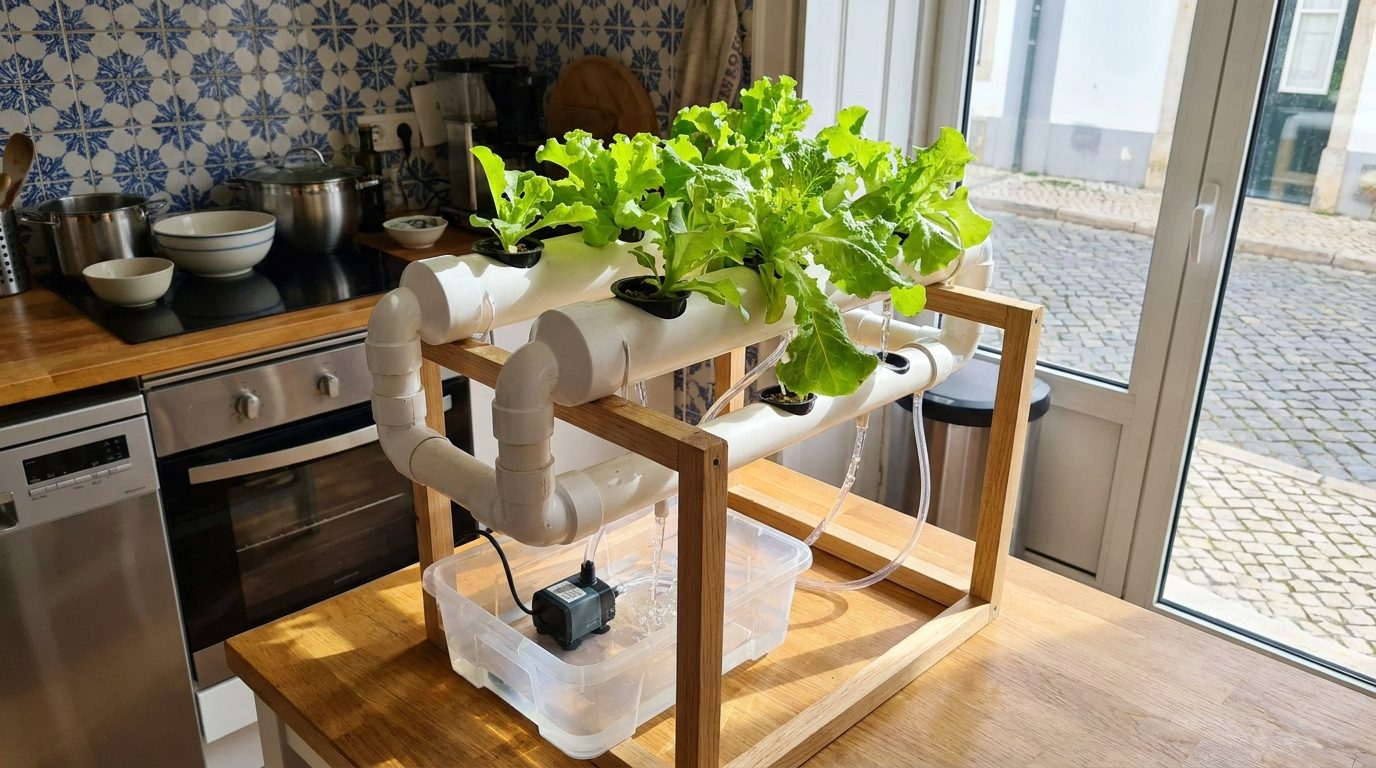
Home hydroponics — the Kratky method
Passive hydroponics with no pumps, no electricity and no timers. Grow lettuce, spinach and herbs in glass jars with a nutrient solution. Ideal for flats and prolonged emergencies.
What is the Kratky method?
Invented in 2009 by Bernard Kratky (University of Hawaii), it is widely regarded as the simplest hydroponic system in the world. Plants are suspended above a reservoir of water with nutrients. As the water level drops, an air gap forms between the water and the roots — "oxygen roots" develop in that gap, supplying the oxygen the plant needs. There are no pumps, no circulation and no electricity. When the water runs out, the plant is ready to harvest.
Advantages in an emergency
Advantages
- Zero electricity — works off-grid
- Little water — uses 90% less than soil cultivation
- No soil — no soil pests, no weeds
- Faster growth — around 30% quicker than in soil
- In a flat with no balcony — only needs light (window or LED)
- Clean — no soil, no smell
Limitations
- Leafy greens and herbs only — tomatoes or peppers do not work well (they drink too much water)
- Specific nutrients — ordinary fertiliser will not do, you need hydroponic ones
- Start plants in soil/rockwool — Kratky is for growing on, not for germination
- Start-up cost — €30-50 for the first complete setup
- Reservoir runs out — single 4-6 week cycle, then start over
Materials needed
Minimum setup (1 lettuce, around €15)
- Dark glass jar of 3-5 L (a large olive jar, a brown beer jar, or a preserves jar wrapped in opaque tape).
- Net pot, 5 cm (€1-2) — you can improvise with a perforated plastic cup.
- Expanded clay (LECA) or rockwool (€2-3/bag) — inert substrate.
- Liquid hydroponic NPK nutrients — from a garden centre (Leroy Merlin) or online. E.g. General Hydroponics Flora trio (€15-25, lasts a year for many plants) or Masterblend.
- pH meter (optional, €5-15) — ideal solution: pH 5.5-6.5.
- Already-germinated seedling (in peat substrate or rockwool) — see germination section.
Why a dark jar?
Light reaching the water encourages the growth of green algae, which compete with the plant for nutrients and oxygen. A dark jar (brown/green glass) or painting it / wrapping it in black tape solves this.
Step by step
- Germinate the seedling separately. In a rockwool cube (or peat pellet), sow 2-3 seeds of lettuce, spinach or herbs. Keep moist. In 7-14 days you will have a seedling with 3-4 leaves.
- Drill the jar lid. A central hole the exact size of the net pot (around 5 cm). The net pot must clip in and hang, with its base inside the jar.
- Prepare the nutrient solution. Fill the jar with tap water (let it stand 24 h to off-gas chlorine, or use filtered water). Add nutrients following the manufacturer's instructions (usually 1-2 ml/L of each nutrient).
- Check the pH (optional). Use a pH meter. Ideal solution: 5.5 to 6.5. If higher, add a drop of white vinegar. If lower, add a pinch of bicarbonate of soda.
- Fill the net pot with expanded clay (LECA). Place the rockwool cube (with the seedling) in the centre. Cover around it with expanded clay.
- Position it. Place the net pot into the drilled lid. Critical: the base of the net pot must lightly touch the water — at least 1-2 cm of root/cube submerged. As the plant grows, the water level drops.
- A bright spot. A window with 4+ hours of indirect light or an LED grow light for 12-16 h/day. Strong direct sun overheats the water — prefer indirect light.
- Do not touch. This is the magic of Kratky: no top-ups. No watering. No circulation. The water drops slowly — in 4-6 weeks the jar is practically empty. When the water reaches the bottom (with the longest roots), the plant is ready to harvest.
- Harvest. For lettuce: pick the outer leaves as needed. For a full harvest: cut the plant at net-pot level. For herbs: pick continuously.
- Start over. Clean the jar with hot water. Start a fresh solution and a new seedling. The cycle begins again.
What to grow with Kratky
| Plant | Works? | Time | Notes |
|---|---|---|---|
| Lettuce | ✓ Excellent | 4-5 wk | The classic. Baby leaf or loose-leaf varieties. |
| Rocket | ✓ Excellent | 3-4 wk | Quick growth. |
| Spinach | ✓ Good | 5-6 wk | Prefers cool temperatures. |
| Swiss chard | ✓ Good | 5-7 wk | Big leaves, continuous picking. |
| Basil | ✓ Good | 5-7 wk | Full sun, continuous growth. |
| Parsley | ✓ Good | 6-8 wk | Slower growing. |
| Coriander | ✓ Good | 4-5 wk | One harvest only. |
| Chives | ✓ Good | continuous | Perennial, years in the same jar with refreshes. |
| Mint | ✓ Good | continuous | Grows fast, continuous. |
| Tomato | ⚠ Tricky | 3-4 months | Drinks lots of water, needs a huge jar (20 L+). |
| Pepper | ⚠ Tricky | 4 months | Same reason. More complex setup. |
| Carrot, potato, root veg | ✗ No | — | Roots need solid space. |
| Courgette, melon, watermelon | ✗ No | — | Too much water, fruits are heavy. |
Hydroponic nutrients — what to buy
Hydroponics needs specific balanced nutrients. Ordinary garden fertiliser does not work — it lacks essential micronutrients or has them in the wrong proportions.
Options in Portugal
- General Hydroponics FloraGro/FloraMicro/FloraBloom (Trio): 3 bottles, 1 year of use across several plants. Around €25-40 (Amazon, hydroponics shops).
- Masterblend 4-18-38: soluble powder + calcium nitrate + magnesium sulphate. Cheaper in the long run, around €30 for 2 kg lasting 2-3 years.
- BioBizz Hydro-Mix: organic, certified bio. Around €20-30.
- GHE Tripack/Plagron Hydro: European alternatives.
Concentration
- Leafy plants (lettuce, spinach, herbs): EC 1.2-1.8 mS/cm
- Fruiting plants (tomato, pepper): EC 2.0-2.5 mS/cm
- No EC meter: follow the manufacturer's doses (1-2 ml/L). When in doubt, go for a weaker dose.
Storing the nutrients
Once mixed in water, the nutrient solution degrades in 7-14 days. Do not prepare large amounts. Solids (Masterblend) keep for years when dry.
Troubleshooting
Yellowing leaves
Cause: nitrogen deficiency, or wrong pH blocking absorption.
Solution: check pH (ideal 5.5-6.5). Refresh the nutrient solution.
Green algae in the water
Cause: light reaching the solution.
Solution: darken the reservoir (opaque tape, dark jar). Wash and restart.
Brown / rotten roots
Cause: too deeply submerged (no oxygen) or water with fungi.
Solution: lower the initial water level, add an oxygenator (3% hydrogen peroxide, 1 ml/L).
Tiny flies (sciaridae)
Cause: humidity and organic matter.
Solution: yellow sticky traps. Reduce surface humidity.
Plant grows but stays small
Cause: not enough light.
Solution: more hours of light (LED 14 h/day minimum), bring the light closer to the plant.
Water runs out before harvest
Cause: reservoir too small for the plant.
Solution: use a bigger jar (5 L+ for lettuce, 10 L+ for tomato).
More advanced systems (for reference)
Kratky is the simplest method. There are other, more productive hydroponic systems but they need extra kit:
- DWC (Deep Water Culture): Kratky + air pump. More oxygen = faster growth. Needs electricity.
- NFT (Nutrient Film Technique): tilted tube with a continuous flow of solution. Commercial.
- Aeroponics: roots sprayed with nutrients. More efficient but complex.
- Aquaponics: hydroponics + fish. The fish fertilise the plants, the plants filter the water. Closed-loop, sustainable system.
For an emergency and for simplicity, Kratky is the obvious choice: zero electricity, zero moving parts, zero maintenance until harvest.