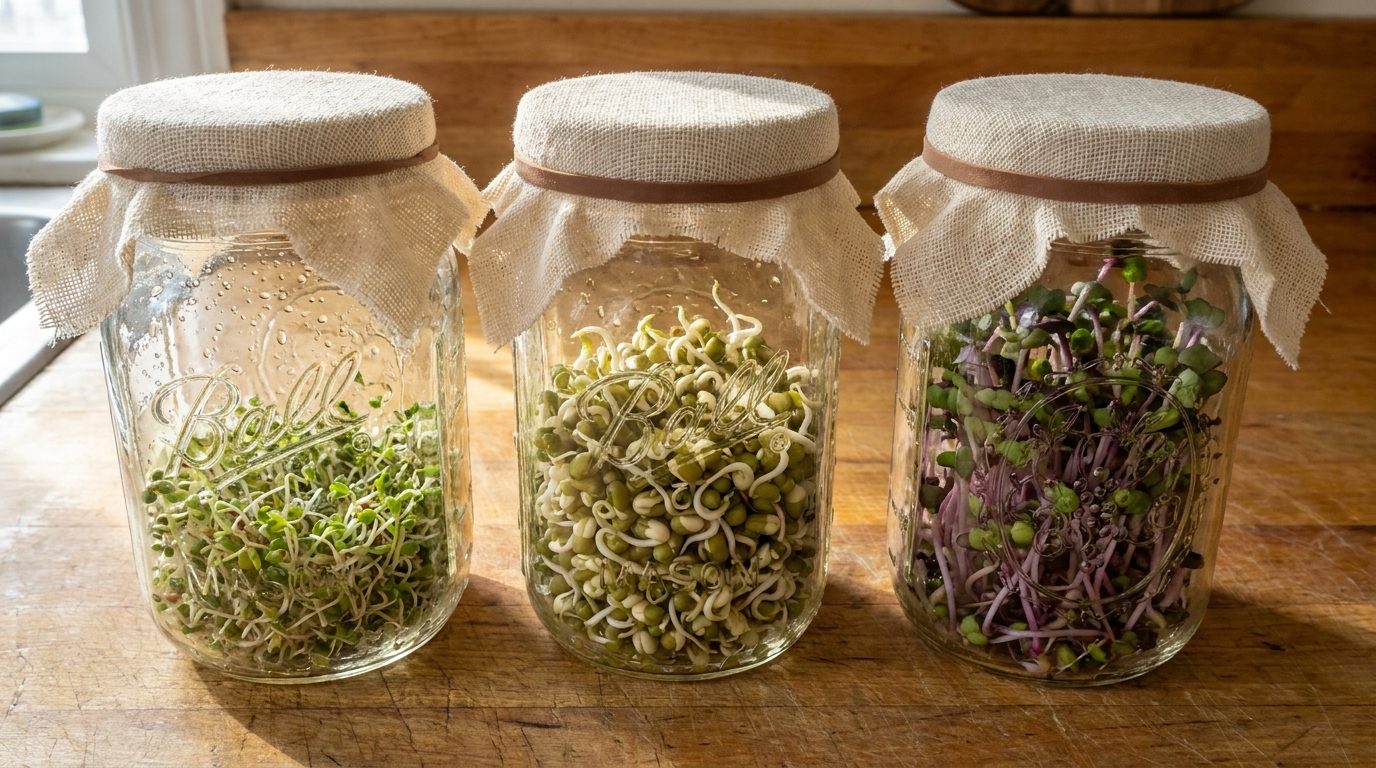
Sprouts — step-by-step guide
The simplest and cheapest way to produce fresh food in an emergency. In 3 to 7 days, with no soil, no sun and no electricity. Just a glass jar and seeds.
Why sprouts?
When a seed germinates, its nutritional value multiplies. Vitamins, enzymes and proteins increase dramatically. A spoonful of dry green lentil seeds (taking up about 1 cm³) turns into 300 g of fresh food in 5 days. In a prolonged emergency — where dry stores dominate the diet — sprouts are the most efficient way to obtain vitamin C and live nutrients.
What you need
Materials (total cost ~5 €)
- 1 glass jar of 1 L (a reused preserve jar works fine)
- Cheesecloth, muslin or tulle (40 cm × 40 cm)
- 1 rubber band or the lid ring
- Tilted draining stand (a bowl works)
- Filtered water (chlorine inhibits germination)
Alternatively: buy a sprouting kit (8-15 €) with perforated lids — makes draining easier.
Seeds (pick one to start)
- Green lentils — the easiest for beginners. 3-5 days.
- Chickpeas — filling, slightly sweet flavour. 3-4 days.
- Mung bean — the classic crunchy Asian sprout. 4-5 days.
- Alfalfa — fine, neutral flavour. 5-7 days.
- Broccoli — peppery, rich in sulforaphane. 4-5 days.
Important: seeds bought in bags from the grocery shop do work, but avoid those that have been treated (label "treated with fungicide"). For maximum safety, use organic seeds certified for sprouting.
Step-by-step (8 steps)
- Rinse and inspect. Place 1-2 tablespoons of seeds in a strainer. Rinse under running water. Discard broken seeds, stones or impurities.
- Soak. Put the seeds in the jar. Cover with filtered water (about 2 cm above the seeds — they will expand). Leave to soak at room temperature:
- Alfalfa, broccoli, radish: 6 hours
- Green lentils, mung: 8 hours
- Chickpeas, pea: 12 hours
- Drain. Cover the jar with the cheesecloth and secure it with a rubber band. Turn it upside down over the sink and let all the water drain. The seeds stay inside, held back by the cheesecloth.
- Tilt. Place the jar at a 45° angle (a bowl helps) with the opening pointing downward. This allows drainage and air circulation. Keep at room temperature, away from direct sunlight.
- Rinse 2-3× a day. Morning, lunchtime and evening: fill the jar with water, swirl gently and drain completely through the cheesecloth. Return it to the tilted stand.
Critical: drain completely. Standing water = mould.
- Observe. Within 24-48 hours you will see small white shoots emerging from the seeds. Keep rinsing.
- Harvest. When the sprout is 1-3× the size of the seed (3-7 days depending on the variety), it is ready. The cotyledons (small leaves) may start to open and turn green — a sign of peak vitamin C.
- Store. Rinse thoroughly one last time. Drain completely (kitchen paper helps). Store in the fridge in an airy container for up to 5 days. Rinse again before eating.
Quick reference table
| Seed | Soak | Ready in | Flavour | Notes |
|---|---|---|---|---|
| Alfalfa | 6 h | 5-7 days | Mild, fresh | Fine, great in sandwiches |
| Green lentils | 8 h | 3-5 days | Earthy, sweet | Beginners — rarely fail |
| Chickpeas | 12 h | 3-4 days | Sweet, nutty | Filling, in salads |
| Mung bean | 8 h | 4-5 days | Crunchy | Asian classic |
| Broccoli | 8 h | 4-5 days | Mildly peppery | Sulforaphane (anti-cancer) |
| Radish | 8 h | 4-6 days | Strongly peppery | Like mild wasabi |
| Sunflower | 8 h | 7-10 days | Crunchy, oily | Hulls need removing |
| Pea | 12 h | 5-7 days | Sweet, green | Like fresh peas |
| Wheat | 12 h | 3-5 days | Sweet | For juices and granola |
Critical safety warnings
NEVER eat sprouts from:
- Raw red kidney beans: they contain phytohaemagglutinin, a toxic lectin that causes severe vomiting and diarrhoea. Even when cooked, sprouted kidney beans must be boiled for at least 10 minutes.
- Raw black, white or pinto beans: same family, same warning. Always cook before eating.
- Tomato, potato, aubergine or pepper: seeds from nightshades contain toxic solanine. These plants are not for sprouting.
- Treated seeds: garden seeds for planting are often treated with fungicides. The label will say "Not for human consumption" or "Treated".
Risk of bacterial contamination
Sprouts are the food most often associated with outbreaks of E. coli and Salmonella, because the warm, humid environment favours bacteria. To minimise risk:
- Wash your hands thoroughly before handling
- Wash the jar well with hot water between batches
- Use seeds from a trusted source (organic or specifically labelled for sprouting)
- Rinse 2-3× a day without fail
- Discard immediately if you notice a rotten smell, slime or unusual colour
- Vulnerable people (pregnant women, young children, the elderly, immunocompromised): cook sprouts before eating
Troubleshooting
Mould (fluffy white patches)
Do not confuse with fine white roots — those are healthy. Mould is fluffy, appears in localised patches and smells bad.
Causes: insufficient drainage, infrequent rinsing, dirty jar.
Solution: discard the entire batch. Wash the jar with boiling water. Start over.
Sour smell
The seeds are "fermenting" because they were left in standing water.
Solution: rinse several times. If the smell persists, discard.
Seeds will not sprout
Causes: old seeds (>3 years), treated, or boiled/roasted.
Solution: try a different batch. Whole dry seeds will germinate; broken or processed ones will not.
Black/dark hulls
Some seeds (sunflower, mung) leave hulls behind. They are not toxic but they taste bitter.
Solution: before eating, dunk the sprouts in water — the hulls float and can be removed by hand.
Continuous rotation system
To have fresh sprouts every day, simply start a new jar every 1-2 days. Within 5 days you have 3-4 jars at different stages — you harvest one and start another.
Example: 4-jar rotation with green lentils (3-5 days)
- Monday: soak jar 1
- Wednesday: soak jar 2 (jar 1 is developing)
- Friday: harvest jar 1 + soak jar 3
- Sunday: harvest jar 2 + soak jar 4
Result: ~300 g of fresh sprouts every 2 days, indefinitely.
Seed reserves for sprouting
1 kg of dry green lentils (~3 €) yields roughly 3 kg of fresh sprouts. For a family of four, sharing 1 jar per day:
- 1 month: ~500 g of dry seeds
- 1 year: ~6 kg of dry seeds
- Variety: 1 kg each of green lentils, mung, alfalfa, broccoli and chickpeas
Dry seeds kept in an airtight jar in a cool, dry place retain their germination capacity for 3-5 years.
How to use them in the kitchen
In salads
Mix with lettuce, tomato, tuna. 1 handful per person.
In sandwiches/wraps
Replace lettuce. Crunchy, more nutritious.
In soups
Add in the last 2 minutes (do not cook longer — they lose nutrients).
In smoothies
Broccoli, alfalfa: 1 handful in a green smoothie.
Stir-fries
Mung is a classic in Asian dishes. 1-2 minutes in the wok.
Cooked
Sprouted lentils and chickpeas cook in half the time of dry seeds.