Heating without grid
How to heat your home without central heating — without dying of carbon monoxide poisoning. Fireplaces, wood-burning stoves, choosing firewood, emergency insulation, layering and hypothermia.
Cold kills silently
In mainland Portugal, more people die of cold inside their homes than many imagine — Portugal has one of the highest winter mortality rates in Europe, made worse by the poor thermal insulation of its housing. January 2026 brought snow at 400 m altitude, school closures and snow-related isolation in dozens of municipalities. Knowing how to heat without central heating — and without dying of carbon monoxide poisoning — is essential.
⚠ Critical warning — carbon monoxide (CO)
Carbon monoxide is the leading cause of accidental death in winter emergencies. NEVER use indoors: brazier, charcoal grill, generator, gas heater without ventilation. See the CO section before continuing.
The 6 off-grid heating methods
1. Traditional fireplace
A Portuguese tradition, especially in the North and Centre. Robust but inefficient.
- Efficiency: 15-30% — most of the heat escapes up the chimney
- Maintenance: chimney cleaned annually (creosote = fire risk)
- Fuel: any dry wood (an advantage in an emergency)
- Advantage: robust, burns small branches to large logs
- Limitations: inefficient, loses heat overnight when it goes out, sparks
- Cost: low (already in the house) or high (new fireplace: €1,500-5,000)
2. Wood-burning stove (or wood-burning insert)
The most efficient choice for wood heating. Closed combustion, air control.
- Efficiency: 60-80% (EN 13240 standard) — 3 to 4 times better than an open fireplace
- Types: freestanding wood-burning stove or wood-burning insert (fitted into an existing fireplace, EN 13229)
- Distributed heat: ducting kit with a fan distributes heat to other rooms (but the fan needs electricity)
- Cooking on top: the upper surface takes pots (cast iron holds up best)
- Cost: €800-3,000 + installation €500-1,000
- Firewood used: 3-5 m³/winter for an average home (50% less than an open fireplace)
3. Pellet stove
Compressed recycled wood pellets. Very efficient but with a critical limitation.
- Efficiency: 85-90%
- Automatic: dosing, ignition, ventilation — all electronic
- ⚠ NEEDS ELECTRICITY to operate (continuous pellet feed, fan)
- NOT useful in a power outage unless you have a large UPS/power station
- Useful in: gas emergencies (strikes, isolated failures) without a power outage
- Cost: €1,500-3,000 + €800/year in pellets
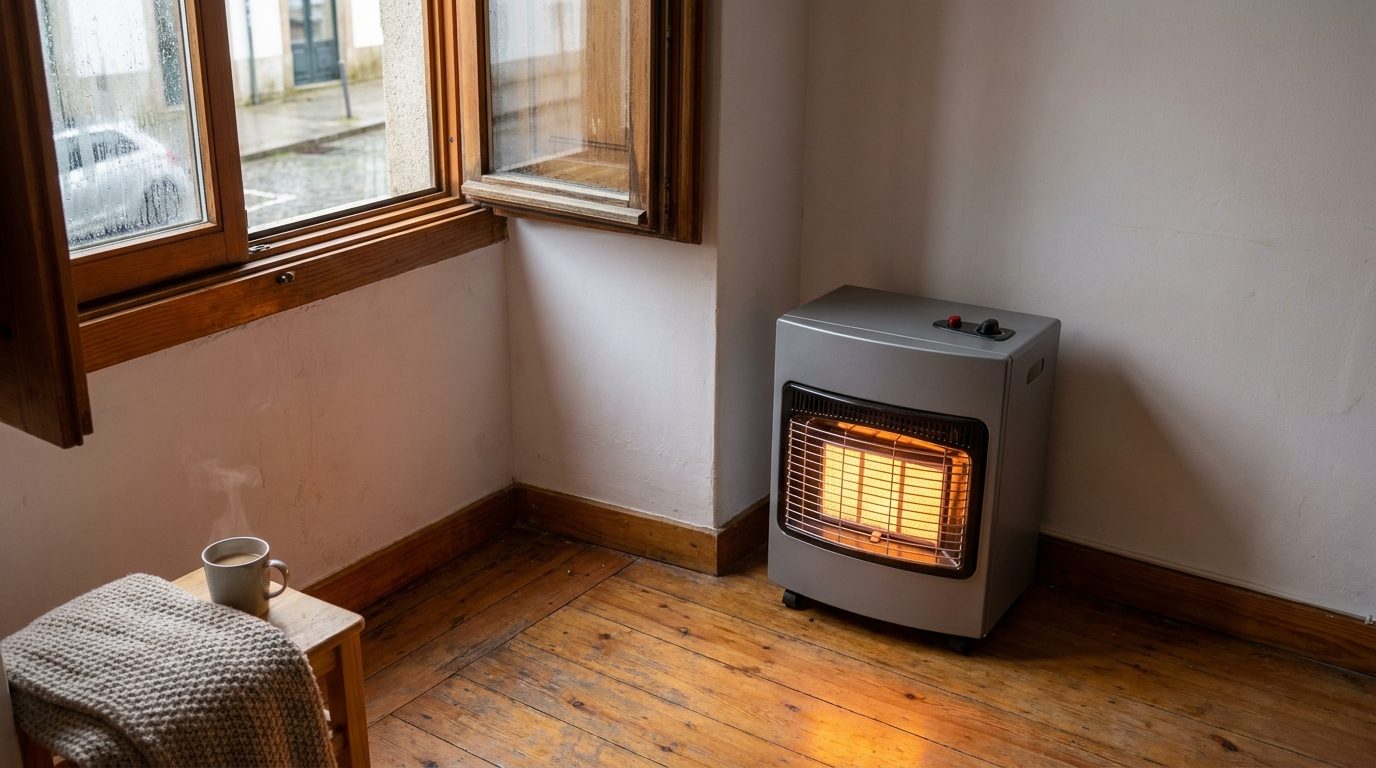
4. Butano/propano heater
Gas bottle + catalytic burner (no visible flame). A portable solution.
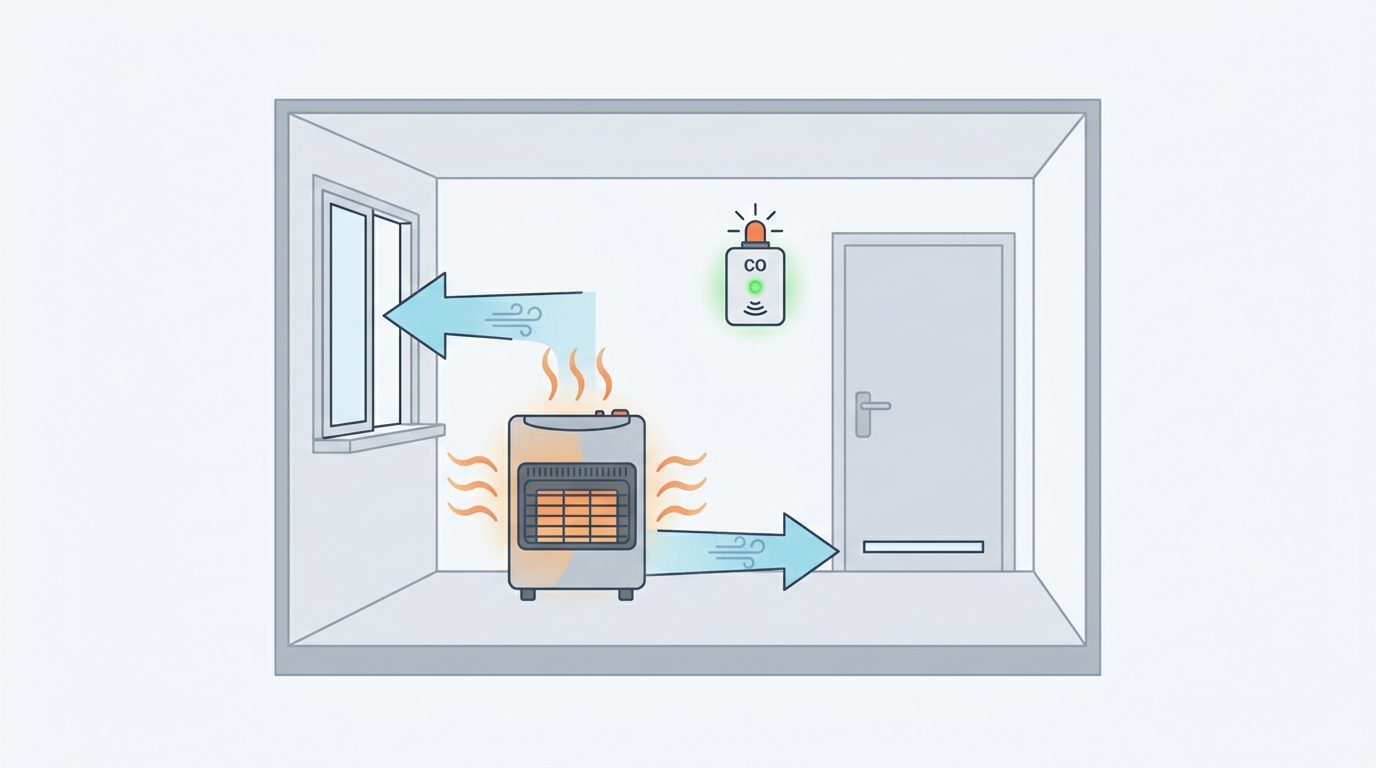
- ⚠ Caution: ONLY in ventilated areas. Produces CO if poorly tuned or starved of air.
- Safe models: ODS sensor (Oxygen Depletion Sensor) or CO sensor — automatic shut-off
- Types: catalytic (no flame, safer) vs ceramic (visible yellow flame)
- Consumption: a 13 kg bottle lasts ~30 hours at medium power
- Cost: €80-150 (appliance) + €30-40 (bottle)
- Good for: spot heating of one room in an emergency
5. Passive solar heating
Make use of sunlight through the windows. Zero cost, zero fuel.
- By day: open the curtains on south-facing windows. Captures heat.
- At night: close thick curtains + a blanket on top. Retains heat.
- Dark colours on south-facing walls/floors absorb more heat
- Tip: black bottles filled with water on south-facing windows. They warm up by day and release heat at night (thermal mass).
- Limitation: only a complementary heat source — not enough for a cold winter on its own
- Advantage: free, no risks, works whenever the sun is out
6. Micro-zone + human layering
In an emergency without other sources, concentrate people and heat in a single room.
- Choose 1 small room, internal (without an external wall if possible), with a door
- Seal gaps with towels/clothes, close the shutters
- Gather the family + blankets, sleeping bags
- Body heat: 4 people generate ~400-500 W (roughly one small heater)
- Reflective thermal blankets (mylar) underneath the regular ones — reflect body heat back
- Candles: 1 candle = 80 W of heat. 4-5 candles in a closed room provide real warmth (but mind CO in a small closed room — open the window 1 cm)
Critical warning — carbon monoxide
The silent killer of winter
Every winter in Portugal there are CO deaths — almost always in families who tried to warm themselves with a brazier, charcoal grill, generator or indoor gas heater. No colour, no smell, no taste. In a closed room with a charcoal brazier, it kills in 4-5 minutes.
NEVER indoors
- Charcoal brazier: kills in minutes. Even in a large room, CO builds up rapidly.
- Charcoal or gas charcoal grill: same. Outdoors only.
- Petrol generator: keep it >6 m from doors and windows. NEVER in the garage (even with the door open).
- Gas oven used as a heater: consumes oxygen, produces CO. Common across southern Europe — causes deaths every year.
- Portable unvented gas heater: even "catalytic" ones need fresh air.
Progressive symptoms
- 50-100 ppm (1-2 h): mild headache, fatigue — easily mistaken for flu
- 200-400 ppm (<1 h): dizziness, vomiting, confusion
- 800+ ppm (minutes): disorientation, unconsciousness, convulsions
- 1600+ ppm: death within 1-2 hours
- 12,800 ppm: death in <3 minutes
Warning signs at home
- The whole family with "flu" symptoms simultaneously
- Symptoms that improve when you leave the house
- Sick pets (more sensitive to CO)
- Yellow flame instead of blue on a gas burner
- Excessive condensation on the windows
- Smell of smoke or combustion gases
CO detector — essential equipment
- European standard: EN 50291 (look for this code)
- Price: €25-50
- Where to place it: 1 per room with a fireplace/wood-burning stove/gas heater. At head height.
- Service life: the sensor ages — replace the unit every 7 years. Sealed batteries last 5-10 years.
- If the alarm goes off: LEAVE THE HOUSE immediately, leave doors/windows open, call 112. Do NOT go back in until firefighters confirm it is safe.
- Where to buy: Leroy Merlin, Worten, Amazon, Maxmat
How to choose firewood
Hardwoods (preferred)
- Oak: ~4,500 kcal/kg. Burns slowly and hot. Excellent.
- Cork oak: ~4,400 kcal/kg. Alentejo tradition.
- Holm oak: ~4,500 kcal/kg. Dense, burns slowly.
- Olive (wood): ~4,200 kcal/kg. Aromatic, perfect for cooking.
- Beech: ~4,100 kcal/kg.
Resinous woods (occasional use)
- Pine: ~3,800 kcal/kg, but burns fast. More creosote in the chimney. More sparks (a hazard).
- Eucalyptus: burns fast. When fresh, it "explodes" with pops and sparks (dangerous). Well-seasoned, it works.
Woods to AVOID
- Painted/treated/varnished wood: releases dioxins, formaldehyde, heavy metals. Toxic.
- Chipboard/MDF/plywood: toxic glues. Do not burn.
- Fresh/green wood: <30% real heat. Lots of creosote. Fouls the chimney.
- Wood with nails: ruins the stove over time.
Firewood moisture
- Ideal: <20% moisture (wood seasoned 1-2 years in the open air)
- How to test (without a meter): knock 2 sticks together. A "hollow/resonant" sound = dry. A "muffled/dull" sound = damp.
- Moisture meter at a DIY shop: €15-30. Press into the ends of the logs.
- Wood with radial cracks at the ends = a sign it is well-seasoned
Prices in Portugal
- Mixed firewood (oak/pine): €80-120/m³
- Quality firewood (cork oak, holm oak): €120-180/m³
- Briquettes: €0.30-0.50/kg (burn hotter than firewood but faster)
- Pellets: €0.30-0.40/kg (15 kg bag ~€5-6)
- Where: agricultural cooperatives, local workshops, AKI/Leroy Merlin (more expensive)
Firewood reserves
How much to keep
| Home | Fireplace | Wood-burning stove (60-80% effic.) |
|---|---|---|
| Small (T1-T2) | 5-8 m³/winter | 2-4 m³/winter |
| Medium (T3) | 8-15 m³/winter | 4-7 m³/winter |
| Large (T4+) | 15-25 m³/winter | 7-12 m³/winter |
How to store it
- Location: covered (porch, lean-to, garden shed) with side ventilation
- Off the ground: on pallets or battens. Stops it absorbing moisture from the ground.
- Space between logs: let the air circulate. Do not pack tight.
- Cut and stack 1-2 years in advance: time to season.
- Cover the top against rain, but not the sides (it needs to ventilate).
Emergency insulation
If the home is not well insulated (a common problem in PT), emergency insulation can cut heat loss by 30-50%. Quick, cheap fixes:
- Seal gaps in doors/windows: adhesive tape, twisted damp towels, rolled-up newspaper in the gap
- Double curtains: thick curtains + a blanket hung over the top
- Clear plastic on the windows: creates a 2nd insulating air layer (used in Eastern Europe). Tape all the way round.
- Insulate the floor: rugs in layers. Cold floors drain body heat.
- Close off all unoccupied rooms: reduces the volume to be heated
- Blanket hung over the front door creates a small lobby (porch) of warm air
- Thick footwear indoors: (lined Crocs, winter boots) — cold feet = cold body
Dressing for an emergency (layering)
3 layers — the fundamental principle
- Base layer (skin):
- Merino wool (best) or synthetic polypropylene
- NEVER cotton — it holds sweat, cools the body (the "cold-wet" effect)
- Close-fitting, not loose
- Mid layer (insulation):
- Wool, fleece, down
- Creates pockets of warm air
- Several thin layers > 1 thick layer
- Outer layer (windproof):
- Waterproof and/or windproof fabric
- Blocks the wind and outdoor moisture
- Preferably breathable (Gore-Tex, or similar)
Critical extras
- Wool hat: the head loses a lot of heat (the "50%" myth — it is closer to ~10%, but still critical)
- Scarf/buff: protects the neck, a major heat-loss point
- Gloves + mittens: mittens are warmer (fingers together share heat)
- Insulated boots + 2 pairs of socks: inner thin wool, outer thick wool
- Mylar thermal blanket (emergency blanket): €1-2. Reflects 90% of body heat. Effective but fragile.
- Sleeping bag (mummy bag): €30-100. Indispensable if there is a real risk of hypothermia.
Hypothermia — first aid
Progressive symptoms
- Mild (35-32 °C): intense shivering, cold skin, slurred speech, slowness
- Moderate (32-28 °C): shivering stops (a serious sign), confusion, drowsiness, loss of coordination
- Severe (<28 °C): unconsciousness, weak/irregular pulse, shallow breathing. Risk of cardiac arrest.
What TO DO
- Move to a warm dry place
- Remove wet clothing and replace with dry clothing
- Warm GRADUALLY with blankets, body heat (a hug, sharing a sleeping bag)
- Warm the trunk before the limbs (chest, armpits, groin — where the major blood vessels are)
- Warm sweetened drinks (tea with honey) — only if the person is conscious and swallowing well
- Call 112 in moderate/severe cases
What NOT to do
- NEVER give alcohol — it dilates blood vessels, increasing heat loss
- NEVER rub frozen limbs — it can damage the tissue (frostbite)
- NEVER warm rapidly with a hot bath or a heater pointed straight at them — it can cause cardiac shock
- NEVER give solid food to a very disorientated person (risk of aspiration)
Winter power-outage plan — checklist
- [ ] CO detector installed, tested and with batteries
- [ ] Firewood reserves: 3-10 m³ seasoned (depending on the home)
- [ ] A sleeping bag for each person (or extra blankets)
- [ ] Reflective thermal blankets (1 per person, costing €1-2 each)
- [ ] Full layering (base + insulation + windproof) per person
- [ ] Hats, gloves/mittens, thermal socks, insulated boots
- [ ] Candles (50-100 units) and safe holders
- [ ] Paraffin or gas lamp (light + some heat)
- [ ] Plan for the concentrated room: which room? how to seal it?
- [ ] Extra calorie reserves — the body burns more energy in the cold
- [ ] Room thermometer (to know if the indoor temperature drops too low)
- [ ] Fuel for fireplace/wood-burning stove (firewood + kindling + matches)
- [ ] Portable gas heater + 2 bottles (backup)
- [ ] Chimney swept before winter (sweep ~€80-150)
Common mistakes — dangerous
- Brazier or charcoal grill indoors: kills in 4-5 minutes.
- Open gas oven as a heater: kills in 30-60 minutes.
- Open-flame gas heater with the windows shut: consumes oxygen, produces CO.
- Pellets in a power outage: the pellet stove needs electricity to run the feed. It will not work.
- Buying damp firewood: 50% less heat, fouls the chimney, fire risk.
- Burning treated wood: releases dioxins, formaldehyde. Toxic.
- No CO detector in a home with a combustion source: a €25-50 piece of kit that saves lives.
- Chimney without an annual sweep: built-up creosote = a real risk of a chimney fire.
- Gathering the family in a room with no ventilation at all: CO2 builds up. Always keep a window open by 1-2 cm.
Related resources
← Cooking without grid
7 ways to cook without electricity or mains gas.
Snow and extreme cold
The risks of cold in Portugal and how to act.
Power outages and cuts
A complete guide to power cuts.
Living without electricity
Strategies for prolonged cuts.
Emergency bag
What to take (including thermal clothing).
First aid
Hypothermia, frostbite and other emergencies.