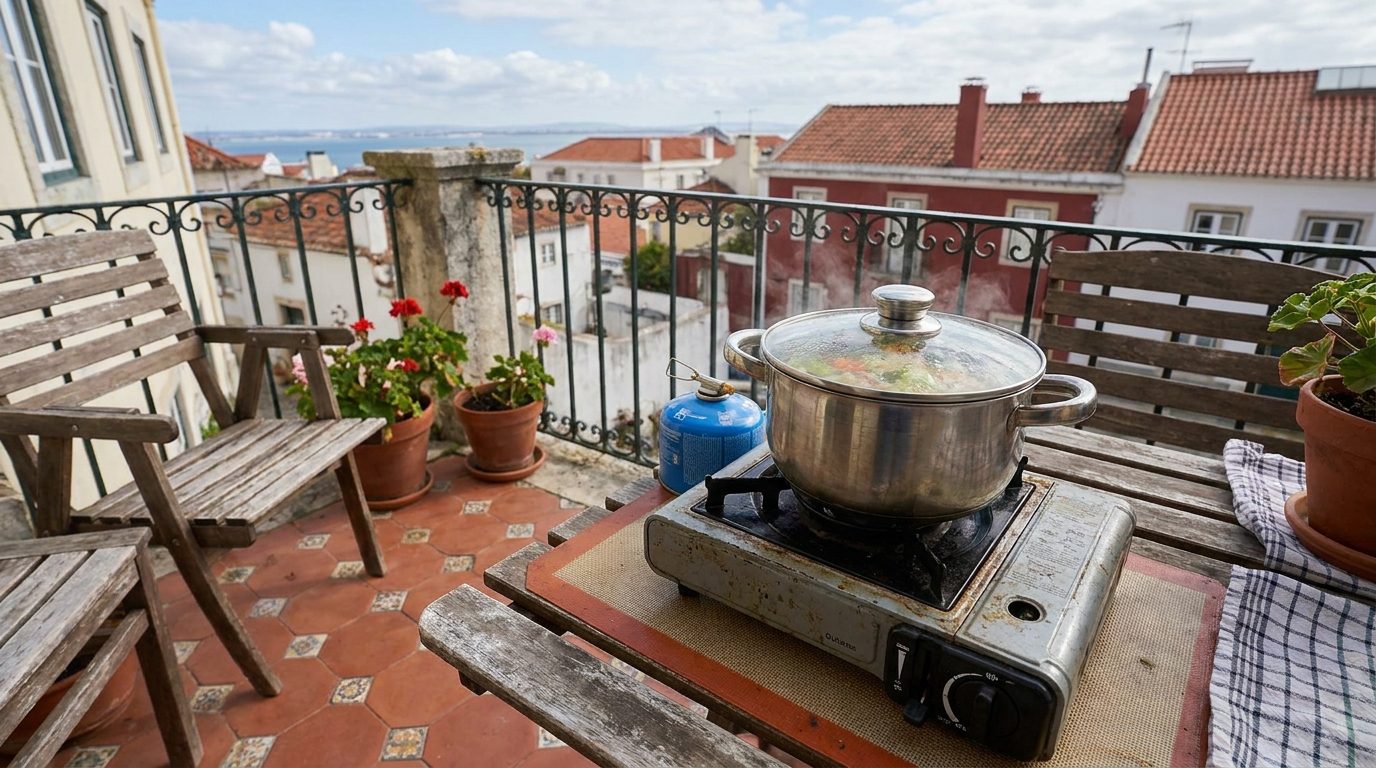
Cooking without grid
Without electricity and without piped gas, there are still 7 effective methods of cooking — some without any fuel at all (solar cooker). In a prolonged blackout, cooking another way is the difference between hot food and food fatigue.
Why this guide?
In Portugal, more than 80% of households depend on piped gas or electric hobs. In a simultaneous electricity blackout and gas failure — possible in an earthquake, severe flooding, or a prolonged supply chain disruption — most families are left with no way to cook. Long-term food reserves (rice, pulses, pasta) need heat to be eaten. Knowing how to cook without the grid is just as important as having the reserves.
⚠ Critical warning — carbon monoxide (CO)
Carbon monoxide (CO) is colourless, odourless and tasteless. It kills within minutes in enclosed rooms. None of the open-flame cooking methods should be used indoors without adequate ventilation. See the CO section at the end of this page before using any stove.
The 7 methods of cooking without grid
1. Gas camping stove
The simplest and quickest method. Butane or propane canisters + a base with a burner.
- Brands in PT: Campingaz, Decathlon Forclaz, Trangia (gas models)
- 230 g canister: €3-6, lasts 2-3 hours on a medium flame
- Time to boil 1 L of water: 4-6 min
- Where to buy: Decathlon, Leroy Merlin, Worten, Sport Zone
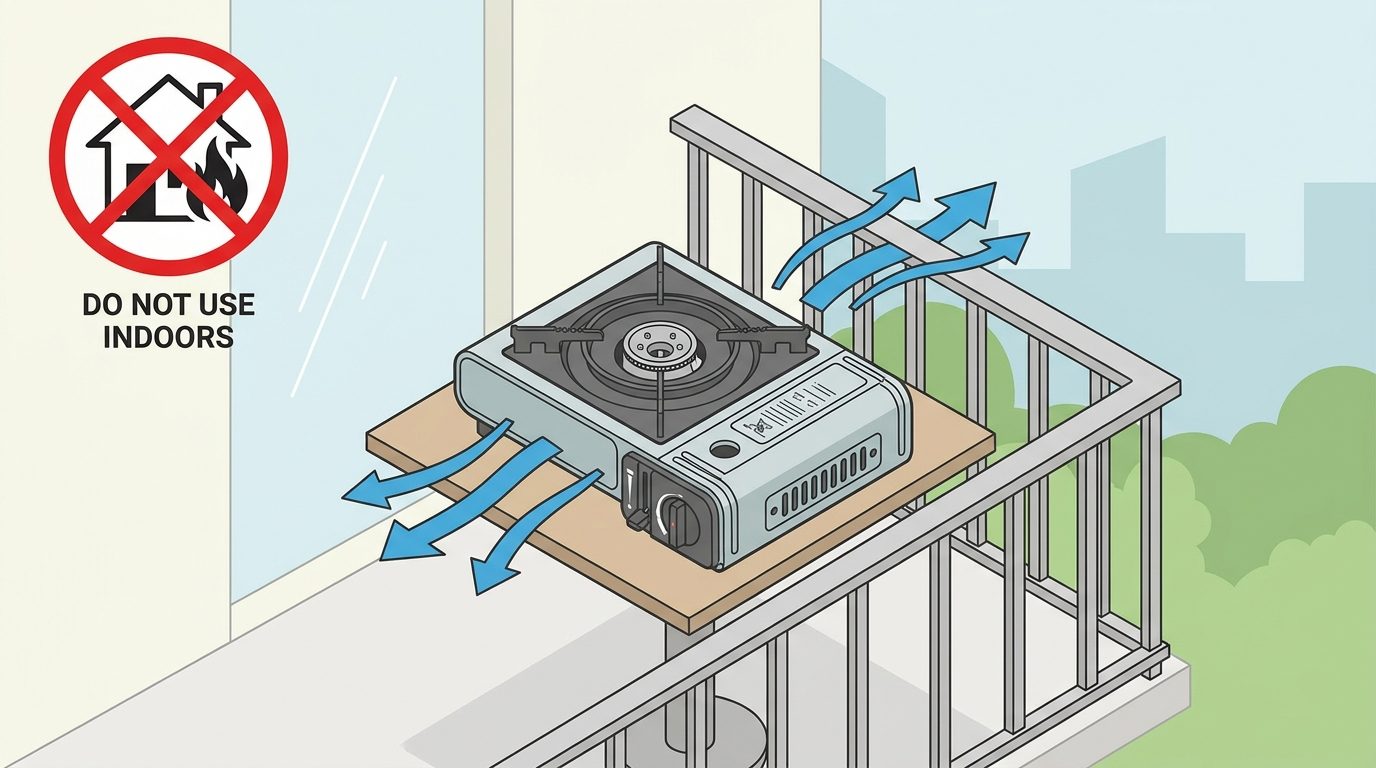
- USE: outdoors (balcony, terrace, garden) or with a window wide open
- Suggested reserves: 5-8 canisters for a family of 4 over 2 weeks
2. Gel alcohol camping stove
Silent combustion, no strong smell. Slower than gas but safer indoors with an open window.
- Systems: Trangia (Swedish aluminium, ~€30-50), DIY with 2 soft drink cans
- Fuel: gel alcohol (most common in PT) or denatured ethanol
- Time to boil 1 L of water: 8-12 min
- 1 L of alcohol: ~€5-8, lasts 8-10 hours on a medium flame
- Reserves: 3-5 L of gel alcohol for 2 weeks
- Advantage: clean flame, little CO if ventilated, easy to light and extinguish
3. Rocket stove
An optimised combustion stove with an internal vertical chimney. Burns thin twigs with very high efficiency.
- Efficiency: 50% less fuel than an open fire
- Near-complete combustion: little smoke, little CO when used outdoors
- DIY: with 4 refractory bricks (~€10) or large tins
- Commercial: Aprovecho StoveTec ~€50, EcoZoom ~€80
- Fuel: dry twigs, thin branches, sticks
- USE: outdoors only
4. Solar cooker
No fuel. Portugal has ~2,700 hours of sunshine per year — an ideal climate.
- Solar box: 100-150 °C. Cooks like an oven (vegetables, rice, soup, bread).
- Parabolic: 200-350+ °C. Cooks like a hob (fries, boils quickly).
- Solar panel (CooKit): 80-120 °C. Simple plastic.
- DIY box: ~€5 (cardboard, aluminium foil, plastic bag) — see section below
- Commercial: GoSun Sport €250, Solavore Sport €200-300
- Limitation: only works in direct sunlight. Useless at night or on cloudy days.
5. Thermal cooker (haybox / Wonderbag)
Briefly bring to the boil on the hob and insulate. The retained heat continues to cook for hours. Saves 70-80% of fuel.
- Principle: 5-15 min on the fire + 2-8 h in insulation = ready
- DIY: box + blankets or hay (see section below)
- Commercial: Wonderbag ~€30-50 (African insulating bag, durable)
- Ideal for: rice, beans, lentils, soup, stew
- WARNING: below 60 °C for >1 h = bacterial risk. Reheat on the fire before eating.
- Bonus: keeps food hot for later meals
6. Fireplace / wood-burning stove
If the house has one, this is the most robust option — it heats and cooks at the same time. See the detailed guide on heating without grid.
- Wood-burning stove: the upper surface accepts pots (cast iron handles it best)
- Open fireplace: tripod with hook, cast iron pots, spits
- Some wood-burning stoves: have a built-in oven
- Advantage: total autonomy if you have firewood reserves
- Limitation: only viable in homes that already have a fireplace/wood-burning stove installed
7. Charcoal grill / barbecue
OUTDOOR USE ONLY. Good for large quantities in a prolonged emergency.
- Type: Portuguese-style grill, kettle (Weber-style), kamado
- Fuel: charcoal or briquettes
- Reserves: 5-10 kg of charcoal in an airtight bag (damp ruins it)
- Fire starters: in sachets, chimney starter (lights without alcohol)
- NEVER: indoors, in a garage or on a closed balcony — CO kills within minutes
- Time: 30-40 min to get ready, 1-2 h of useful cooking time per load
Critical warning — carbon monoxide (CO)
The silent killer
Carbon monoxide is the leading cause of accidental death in blackouts and disasters worldwide. It kills more than any other non-traumatic cause in emergencies. In the USA, >400 people/year die from CO unrelated to fires alone. In Portugal, dozens of deaths each year — many in families trying to heat themselves or cook with a brazier, barbecue, or indoor generator.
How to recognise CO poisoning
Symptoms progress with exposure:
- Mild (50-100 ppm, 1-2 h): mild headache, fatigue — "like flu that won't go away"
- Moderate (200-400 ppm, <1 h): severe headache, dizziness, confusion, vomiting
- Severe (800+ ppm, minutes): disorientation, unconsciousness, convulsions
- Lethal (1,600+ ppm): death within 1-2 hours. At 12,800 ppm, death in <3 minutes.
Warning signs at home
- Several people with flu-like symptoms at the same time
- Symptoms that improve when you leave the house
- Pets falling ill (more sensitive to CO)
- Yellow/orange flame (instead of blue) on a gas burner
- Excessive condensation on windows near combustion appliances
NEVER do indoors
- Petrol generator (keep it >6 m from any door/window)
- Charcoal barbecue
- Brazier (kills in 4-5 minutes in an enclosed room)
- Portable gas heater without ventilation
- Gas oven used for heating
- Gas camping stove without a window wide open
CO detector — essential equipment
- European standard: EN 50291 (look for this code on the product)
- Price: €20-50 at Leroy Merlin, Worten, Amazon
- Batteries: last 5-10 years (sealed models)
- Replace the unit every 7 years: the sensor ages
- Where to place it: 1 per room with a combustion source (kitchen, living room with fireplace, nearby bedrooms)
- Height: at head height (CO mixes with air)
- If the alarm sounds: LEAVE the house immediately, open doors and windows, call 112
DIY solar cooker — step by step
Simple solar box (~€5 in materials)
Reaches 100-150 °C in direct sunlight. Cooks like an oven: rice, vegetables, pulses in water, soups, boiled eggs.
- Large cardboard box (an appliance box works). Minimum 40×40×40 cm.
- Line the interior with shiny aluminium foil, reflective side facing in. Glue with white glue.
- Transparent cover: stretch a plastic bag over the opening, secure with adhesive tape. Or use acrylic/glass.
- Secondary reflector: a hinged cardboard flap also lined with foil, at about a 60° angle to concentrate more light.
- Black pot (matt, not shiny) inside the box. Paint an old pot lid with heat-resistant black paint if necessary.
- Aim at the sun: adjust every 30-60 min to follow the sun.
- Typical cooking times: rice 2-3 h, soup 3-4 h, soaked pulses 4-6 h.
Advantages: zero fuel, zero CO risk, food does not burn (leaving it for many hours does not spoil it). Limitations: only with direct sun, slower than gas. In Portugal it works very well from April to October.
Thermal cooker (haybox) DIY — step by step
The oldest method of saving fuel
Used on a large scale across Europe during both World Wars. The principle is simple: food at boiling point already has enough thermal energy to finish cooking — you just have to insulate it so the heat does not escape.
- Wooden box or rigid basket with a lid. Size ~30 cm on each side.
- Line with insulation: thick wool blanket, hay, straw, polystyrene, or compressed newspaper.
- Central cavity the size of the pot plus 5 cm in each direction.
- Cook normally on the hob until vigorously boiling. Continue 5-15 min depending on the food (see table below).
- Transfer the COVERED pot quickly to the haybox.
- Cover with a cushion or blanket on top to seal in the heat.
- Wait: do not open until the full time has passed. Each time you open it, you lose heat.
Time table
| Food | Boiling on the hob | Time in the haybox |
|---|---|---|
| Rice | 5 min | 45-60 min |
| Pasta | 3 min | 20-30 min |
| Soup | 10 min | 1-2 h |
| Lentils (soaked) | 10 min | 1-2 h |
| Beans (soaked 12 h) | 20-30 min | 4-6 h |
| Chickpeas (soaked 12 h) | 30 min | 4-6 h |
| Meat stew | 20 min | 4-6 h |
| Oats / porridge | 3 min | 20-30 min |
⚠ Caution — food safety
The "danger zone" for bacterial growth is between 5 °C and 60 °C. If the temperature of the pot drops below 60 °C for more than 1 hour, there is a risk of bacterial proliferation. Always reheat on the hob until boiling before serving. This is not the same as an electric slow cooker (which holds 80 °C constantly).
Fuel reserves
| Fuel | How much to store | Shelf life | Price | Notes |
|---|---|---|---|---|
| Butane canisters 230 g | 5/person for 2 weeks | 5+ years | €3-6/unit | Sealed, kept cool <30 °C |
| 13 kg gas bottle (orange) | 1-2 per family/month | indefinite | €30-40 | Needs a compatible camping stove |
| Gel alcohol | 3-5 L | 2-3 years | €5-8/L | Sealed bottle, away from flame |
| Barbecue charcoal | 5-10 kg | indefinite | €1-3/kg | Airtight bag — damp ruins it |
| Firewood (winter) | 3-10 m³ | indefinite | €80-150/m³ | Dry <20% moisture. See heating page. |
| Briquettes / pellets | 50-100 kg | 1-2 years | €0.30-0.50/kg | Dry storage only. Pellets do not work without electricity in most wood-burning stoves. |
| Fire starters / matches | 5 boxes + 100 matches | indefinite | €3-10 | Waterproof matches in a sealed bag |
Common mistakes — dangerous
- Gas camping stove inside a closed house: consumes oxygen, produces CO. ALWAYS balcony/outdoors or a window wide open.
- Stockpiling gas canisters in a hot place (>50 °C): pressure rises, they can explode. Never in a car in the sun or in the loft.
- Cooking in a haybox without reheating beforehand: below 60 °C for hours = risk of botulism, salmonella. Always reheat on the hob.
- No CO detector at home with fireplace/wood-burning stove/gas heater: €25 of equipment that saves lives.
- Forgetting matches/lighter in your reserves: having the best stove in the world with no way to light it is useless. 3+ lighters and 5 boxes of matches.
- Confusing denatured alcohol with 70% sanitising alcohol: only the denatured/ethanol burns well. Sanitiser has too much water.
- Using barbecue charcoal indoors: produces more CO than practically any other fuel. Kills in 4-5 min in an enclosed room.
Emergency cooking plan
Minimum checklist
- [ ] 1 gas camping stove + 5 spare canisters
- [ ] 1 alcohol stove (Trangia or DIY) + 3 L gel alcohol
- [ ] 1 medium pot and 1 cast iron frying pan (resist any fire)
- [ ] Simple box + wool blanket for haybox
- [ ] 5 boxes of matches + 3 lighters (2 standard, 1 piezoelectric)
- [ ] Fire starters (sachets in a sealed pack)
- [ ] CO detector (EN 50291 standard)
- [ ] 5 kg bag of charcoal (if you have an outdoor barbecue)
- [ ] Drinking water reserves (cooking uses a lot)
Estimated total cost: €150-300. An investment that lasts 5-10 years.
Related resources
Heating without grid →
How to heat your home without central heating — without dying of carbon monoxide.
Power outages
Complete guide to power cuts.
Living without electricity
Strategies for prolonged outages.
Food preservation
How to preserve food without a fridge.
Food reserves
How much to store for 1 month to 1 year.
Gas leak
What to do and what never to do.