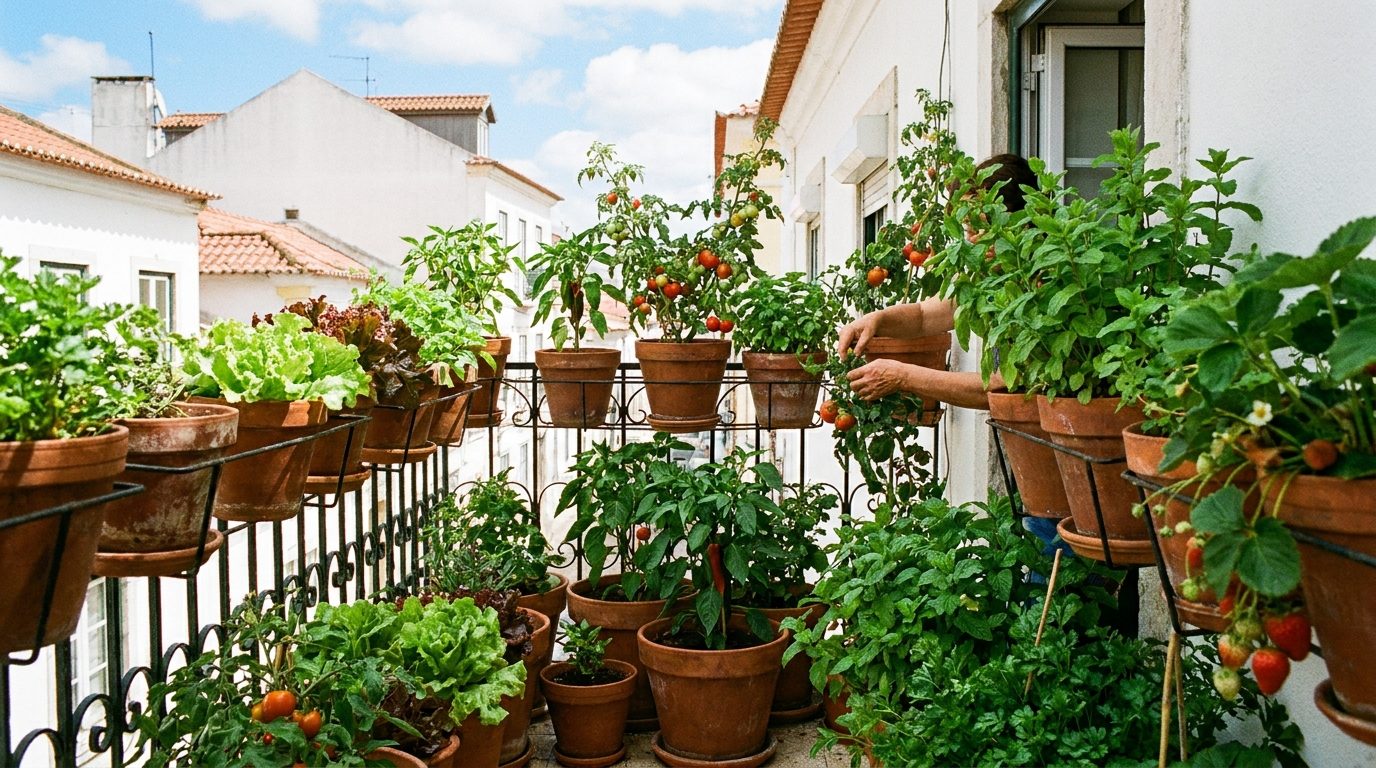
Apartment garden
On a 2 m² balcony you can grow fresh food year-round. In a prolonged emergency, fresh vegetables prevent vitamin deficiencies and complement long-term reserves.
Why an apartment garden?
Dry reserves (rice, pasta, legumes) provide calories but do not supply vitamin C or fresh vitamins. In a prolonged emergency (weeks or months), a home garden is the simplest and cheapest way to prevent scurvy and maintain a balanced diet. Even inside an apartment, a jar of sprouts produces food in 5 days without soil, sun or electricity.
The 4 levels of apartment gardening
Start with level 1 and move up as you gain space, time and budget. You don't need to do everything — each level on its own improves your food autonomy.
Level 1 — Sprouts
3 to 7 days. Fresh food without soil, without sun and without electricity. Just a glass jar and seeds. Ideal to start today. Cost: 5 € (jar).
Lentil, chickpea, pea, alfalfa, broccoli, radish, sunflower
Level 2 — Microgreens
10 to 25 days. Young plants with up to 40 times more nutrients than mature vegetables. They fit on the countertop. Cost: 20-30 € (trays + substrate).
Rocket, beetroot, broccoli, radish, sunflower, pea, purple basil
Level 3 — Potted plants
4 weeks to months. Vegetables and herbs in pots on the balcony, windowsill or terrace. Requires at least 4 hours of sun. Cost: 50-150 €.
Cherry tomato, lettuce, spinach, pepper, cabbage, aromatic herbs
Level 4 — Home hydroponics
4 to 6 weeks. Kratky method: no soil, no pumps, no electricity. Lettuces and herbs in glass jars with nutrient solution. Cost: 30-100 €.
Lettuce, spinach, basil, parsley, coriander (leaves)
Comparison: which to choose?
| Level | Time | Initial cost | Space | Electricity | Calories/day |
|---|---|---|---|---|---|
| Sprouts | 3-7 days | 5 € | 30 cm² countertop | No | ~50 (1 jar/day) |
| Microgreens | 10-25 days | 20-30 € | 1 shelf | Optional (LED) | ~30 |
| Balcony pots | 4 wks - 4 months | 50-150 € | 1-2 m² balcony | No (with sun) | ~300 |
| Kratky hydroponics | 4-6 weeks | 30-100 € | 1 shelf | Optional (LED) | ~100-500 |
Reality: an apartment garden is supplementary, it does not replace food reserves. It complements them with fresh vitamins and minerals. For real caloric self-sufficiency you need land (min. 100 m² per person).
Where to start?
30-day plan to start a home garden
- Day 1: buy a 1 L glass jar, gauze, an elastic band and a packet of lentils. Start your first sprouts (detailed guide).
- Day 5-7: first harvest of sprouts. Start a second jar in parallel (continuous rotation).
- Day 10: buy 1 perforated tray, 1 bag of coconut fibre and 1 packet of rocket or radish seeds. Start your first microgreen.
- Day 24: first microgreens harvest. Restock.
- Day 30: evaluate whether you want to move up to balcony pots. Buy a 5 L pot, lettuce or aromatic herbs, and plant.
In 30 days you have three continuous sources of fresh food at home, with a total cost under 50 €.
Common mistakes to avoid
- Overwatering: the leading cause of plant death in apartments. Soil should be moist, not waterlogged.
- Pots without drainage: roots suffocate. Always have holes in the bottom + a saucer.
- Garden soil in pots: it compacts and doesn't drain. Use a substrate made for pots (peat + perlite).
- Lack of sun: plants need light. North-facing window = LED grow light required.
- Planting everything at once: everything matures together and then runs out. No rotation = no continuous harvest.
- Raw red kidney beans: contain toxic phytohaemagglutinin. NEVER eat raw red bean sprouts — only cooked.
Personal seed bank
In a prolonged emergency, seeds become a critical resource. Building a small personal seed bank is simple and cheap.
- Heirloom seeds: they reproduce true to type, unlike F1 hybrids. Look for traditional Portuguese varieties.
- Storage: airtight jar + silica gel sachet, in a cool (10-15 °C), dry and dark place.
- Average shelf life: 3-5 years for most. Onion and carrot: 1-2 years. Tomato and legumes: 5+ years.
- Where to buy in PT: Casa das Sementes (Lisbon), Cantinho das Aromáticas, ProSpecieRara Portugal, local seed-swap networks (organic markets).
For a family of 4, 1 year:
- Tomato: 1 teaspoon (~200 seeds)
- Lettuce: 1 coffee spoon (~300 seeds)
- Beans: 1 cup (~300 seeds)
- Portuguese cabbage: 1 coffee spoon (~200 seeds)
- Carrot, onion, leek: 1 sachet each
Composting in an apartment
Bokashi — the ideal method for apartments
Bokashi is an anaerobic fermentation (without oxygen) that processes kitchen scraps without bad smell. It accepts meat, fish, dairy and cooked food — things that traditional compost does not accept.
- Equipment: two airtight buckets with a tap (kit ~30-50 €).
- Activator: bokashi bran (effective microorganisms EM-1) — 1-2 handfuls per layer.
- Process: add scraps, sprinkle bran, press down, seal airtight. 2 weeks to ferment.
- After fermenting: bury in a pot or planter. In 2-4 weeks it turns into rich compost.
- Bokashi liquid: drains through the tap. Dilute 1:100 in water — potent liquid fertiliser.
Advantage in an apartment: no smell, no flies, sealed. It can stay under the sink.